
Pre-1933 Gold
Pre-1933 gold refers to the 90 percent gold US coins struck for circulation before American gold coinage ended in the 1930s.
Pre-1933 gold is the term for United States gold coins struck for circulation before American gold coinage came to an end in the 1930s. The series covers four working denominations: the $2.50 quarter eagle, the $5 half eagle, the $10 eagle, and the $20 double eagle. All of them were struck in 90 percent gold.
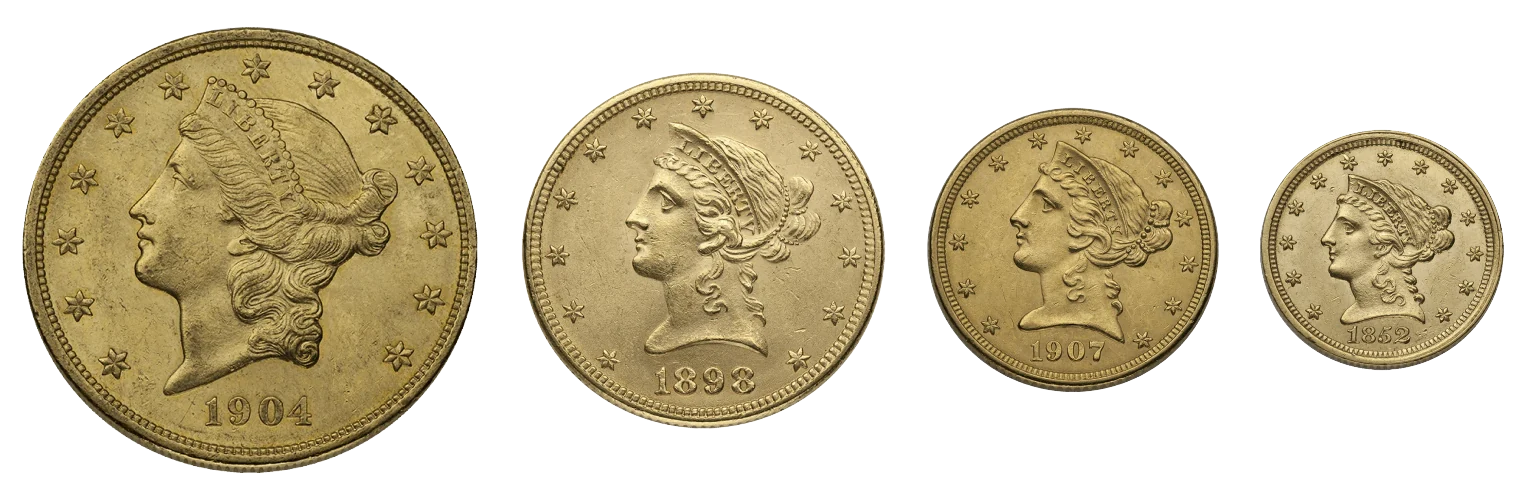
- $20
- $10
- $5
- $2.50
Because the alloy is fixed, the gold content follows directly from the denomination. The $20 double eagle contains .9675 troy oz of gold, and the smaller denominations scale down proportionally. That makes the metal side of these coins easy to calculate. The collector side is not so simple, since date, mint, type, and condition all bear on what a given piece is worth. This is where numismatics and bullion overlap.
Gold coinage was withdrawn from circulation during the 1930s, and the surviving population reflects that history.
One practical note for retirement buyers: pre-1933 US gold is 90 percent fine and generally does not meet the fineness minimum for an IRA, so it is normally held outside a retirement account.
Bring pre-1933 gold to Texas Bullion Exchange for a free appraisal and a specialist will identify and evaluate each piece.