
Pre-1933 US Gold Coins: An Overview
What pre-1933 US gold coins are, the $2.50, $5, $10 and $20 denominations, the major design types, why certification matters, and how they are valued.
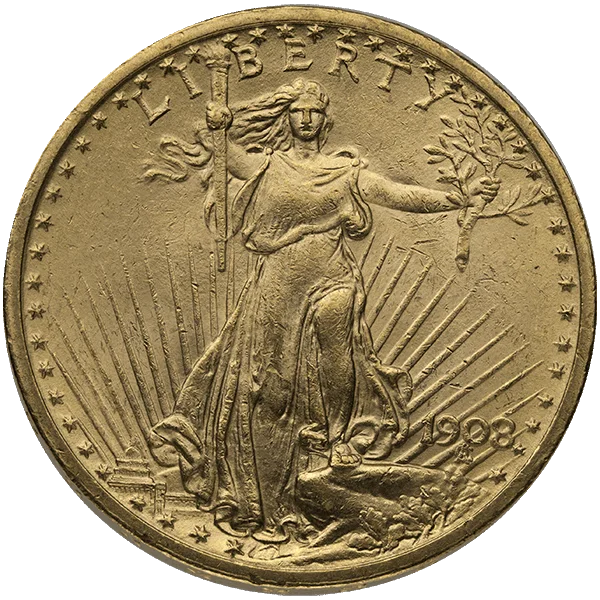
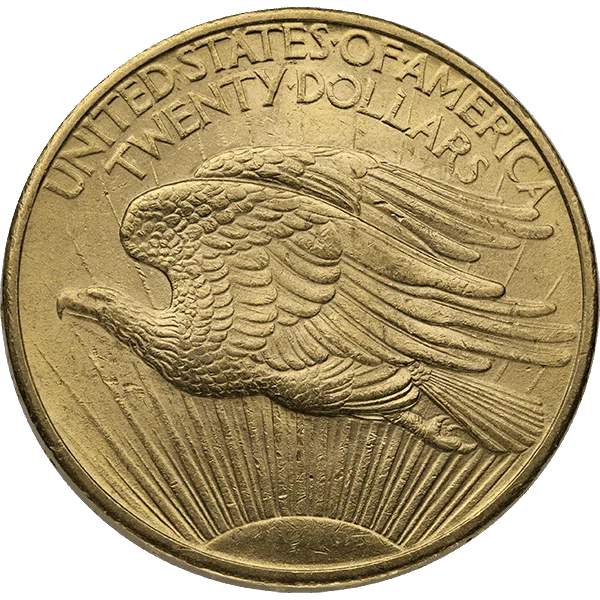
Pre-1933 US gold refers to the gold coins the United States Mint struck for actual circulation, before circulating gold coinage came to an end in the 1930s. These were spending money. They passed through banks, businesses, and hands, and the ones that survive today are the remainder of a monetary system the country no longer uses.
That history is why these coins occupy a different place from modern bullion. A pre-1933 gold coin has a gold value like any other gold coin, and it also has a collector value that depends on which coin it is and what condition it is in. Understanding both halves is the key to knowing what you have.
The denominations still commonly traded
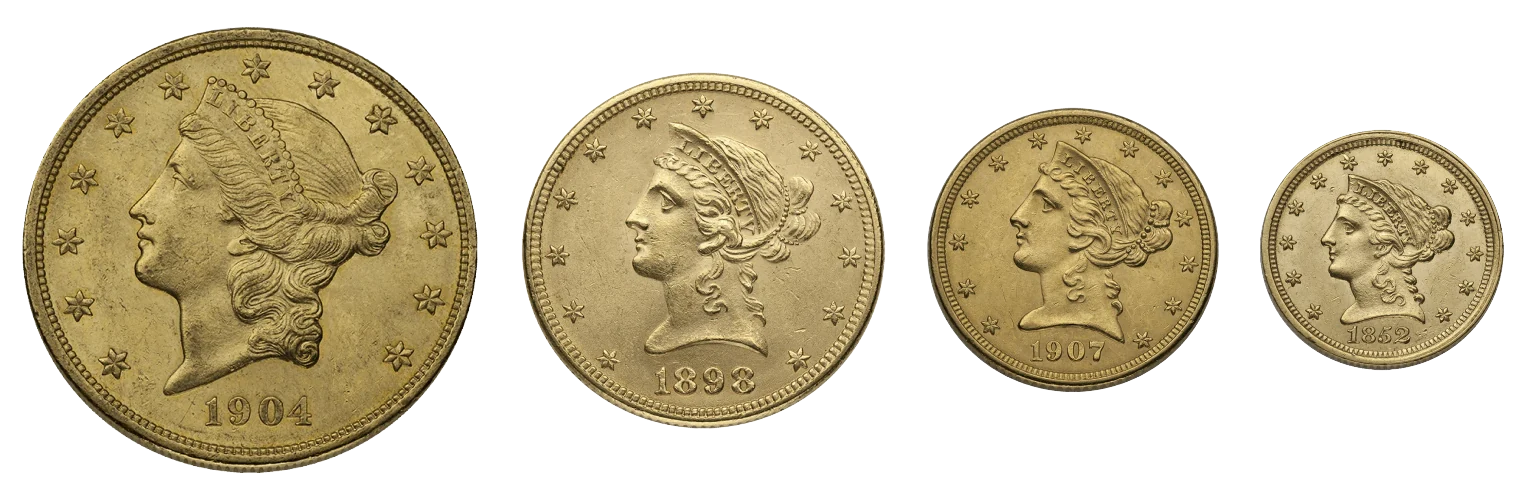
Four denominations make up almost everything you will encounter in the market:
- $2.50 quarter eagle — the smallest of the four, and the smallest gold denomination still widely traded
- $5 half eagle — a mid-size piece produced across a long span of US Mint history
- $10 eagle — the coin from which the "eagle" naming convention derives
- $20 double eagle — the largest, and by a wide margin the most commonly traded of the group
All four are 90 percent gold and 10 percent copper. The copper was there for the same reason it is in modern 22 karat coinage: pure gold is too soft to survive circulation. The double eagle contains .9675 troy ounces of gold, which is the figure most often quoted when these coins are priced against the metal market. The smaller denominations contain proportionally less gold, following the same 90 percent standard.
- $20
- $10
- $5
- $2.50
Smaller gold denominations were struck at various points in US Mint history and turn up occasionally, but the four above are what most dealers stock and most buyers are asking about.
The major design types collectors encounter
Within those denominations, the market sorts coins by design type. A few types account for most of what trades.
Liberty Head designs
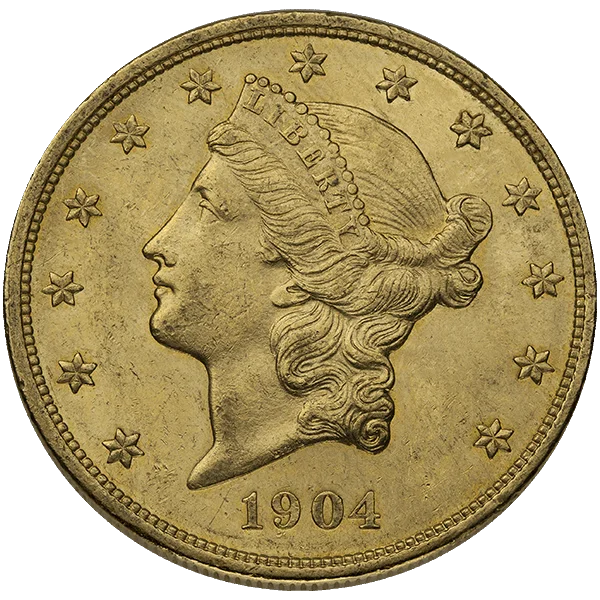
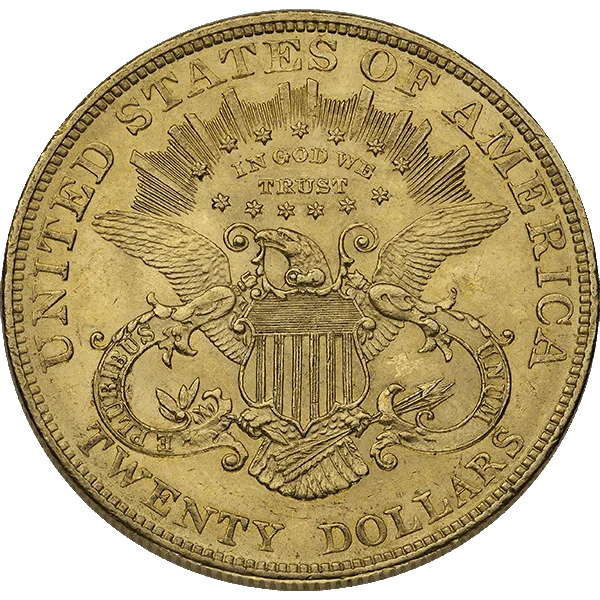
The Liberty Head types, also called Coronet types, show a left-facing bust of Liberty wearing a coronet on the obverse, with a heraldic eagle on the reverse. Variations of this design ran on the quarter eagle, half eagle, eagle, and double eagle across a long stretch of the nineteenth century and into the early twentieth.
These are the workhorse coins of the series. Circulated Liberty Head pieces in common dates are the most straightforward pre-1933 gold to buy and sell.
The Saint-Gaudens double eagle
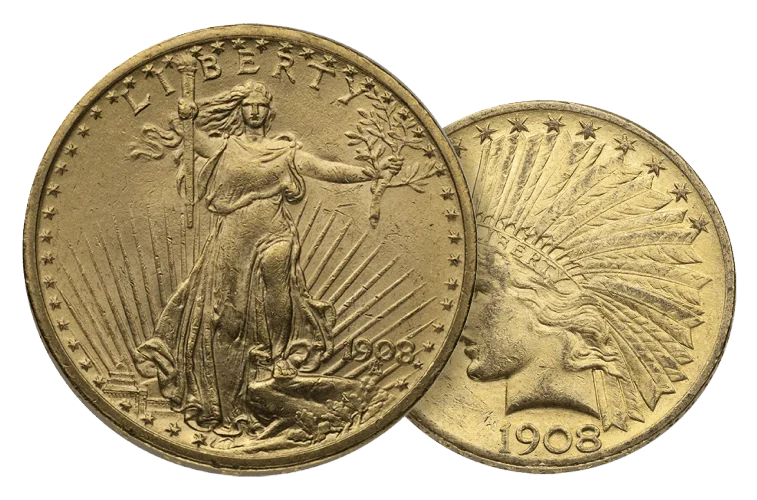
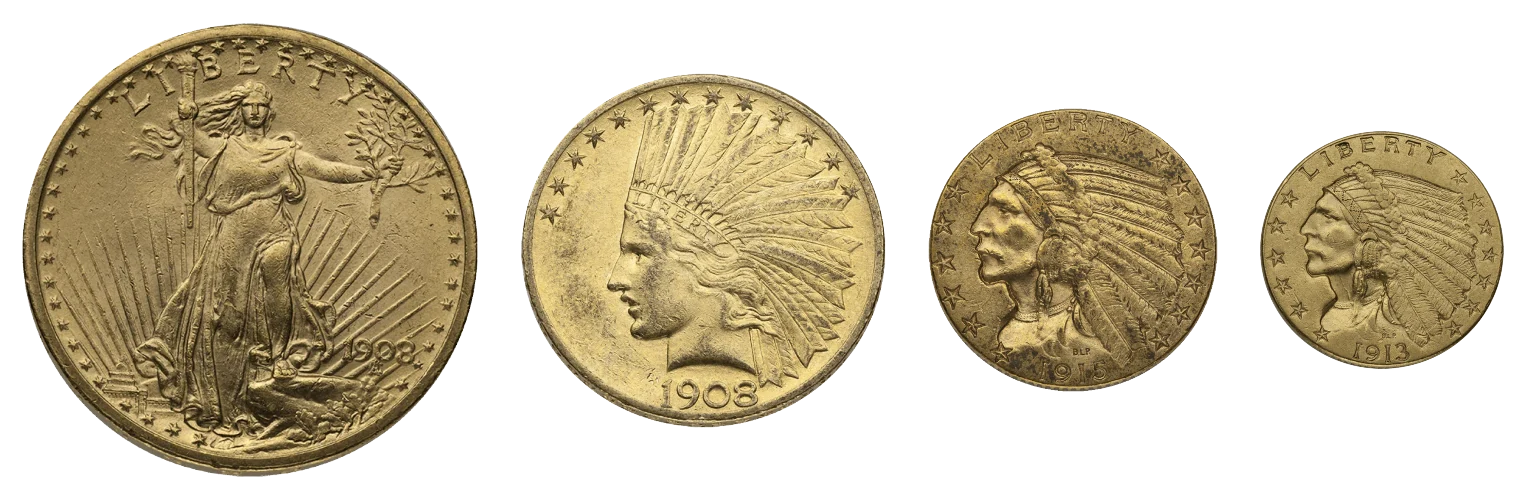
The $20 Saint-Gaudens, designed by Augustus Saint-Gaudens, replaced the Liberty Head double eagle in the early twentieth century. The obverse shows Liberty striding forward with a torch and olive branch, rays behind her; the reverse shows an eagle in flight. It is widely regarded as the most beautiful coin the United States has produced, and the same Liberty figure was later adapted for the modern American Gold Eagle.
Because it is both the largest common denomination and the most admired design, the Saint is the piece most people picture when they hear "pre-1933 gold."
Indian Head designs
The Indian Head types replaced the Liberty Head designs on the smaller gold denominations in the early twentieth century. The $2.50 and $5 Indian Head coins are unusual in American coinage because the design is incuse, meaning the devices are recessed below the field rather than raised above it. Those two were designed by Bela Lyon Pratt.
- $20
- $10
- $5
- $2.50
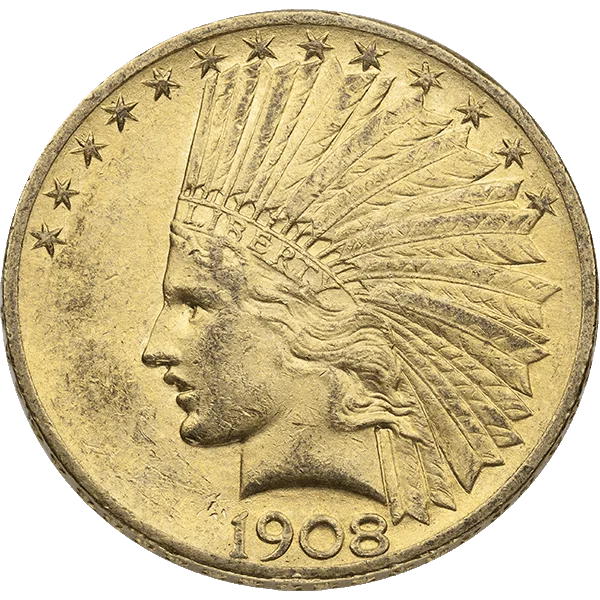
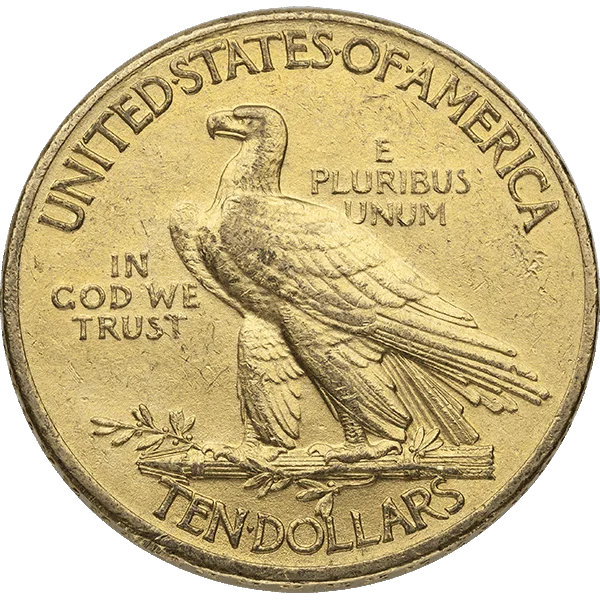
The $10 Indian Head eagle uses a raised design showing a Liberty head wearing a feathered headdress, with a standing eagle on the reverse.
The incuse $2.50 and $5 coins deserve a note of caution. Because the design sits below the field, dirt collects in the recesses and the high points of the field wear first. Grading these types is genuinely harder than grading raised-design coins, and cleaning damage on them is common.
What happened to circulating gold coinage
US gold coins circulated as money until the 1930s, when the country moved away from gold coinage during the economic crisis of that decade. The federal government called in gold coin held by the public and directed it to be turned in, and the Mint stopped producing gold coins for circulation. A great deal of what was surrendered was subsequently melted.
Coins survived in a few ways. Some were held abroad in foreign bank vaults and were never subject to the recall. Some stayed with collectors under exemptions for numismatic holdings. Some simply were not turned in. Later, coins repatriated from European banks came back into the American market, which is why many surviving double eagles show European storage bag marks rather than circulation wear.
Owning these coins today is entirely legal and ordinary. They are bought and sold openly by dealers across the country.
Why these coins carry both metal value and collector value
Every pre-1933 gold coin has a floor set by the gold in it. Below that floor, it makes more sense to melt the coin than to sell it, so the metal market puts a hard bottom under the price.
Above that floor sits whatever the coin is worth as a coin. That part depends on how many people want that particular date and mint mark in that particular condition, and it can range from a small addition to a multiple of the metal value. A common-date, well-circulated double eagle trades close to a bullion coin, with a modest addition for the fact that it is a scarce historical object rather than a current product. A better date, or a common date in exceptional condition, is bought and sold as a collector coin, and the gold content stops being the main factor entirely.
The gap between those two categories is the single most important thing to understand about this market, and it is why a stack of gold coins that all look alike can hold pieces of very different value.
Common dates versus better dates and high grades
A "common date" is a date and mint mark combination that survives in enough quantity that supply meets collector demand comfortably. These trade as a group, and dealers quote them by type and condition rather than researching each one.
A "better date" is a date and mint mark that is harder to find, either because fewer were made or because fewer survived. These are quoted individually.
Condition works the same way. A coin that circulated heavily is worth what its type and date support. The same coin in an exceptional state of preservation may be scarce in that condition even if the date itself is common. This is where the coin grading scale does real work, because a difference of a few points can change which market a coin belongs to.
Both variables interact, and neither is something to judge by eye from a photograph. A key date in poor condition and a common date in outstanding condition can end up in similar territory by very different routes.
Why certification matters here
Pre-1933 gold is one of the areas where third-party certification earns its cost most clearly.
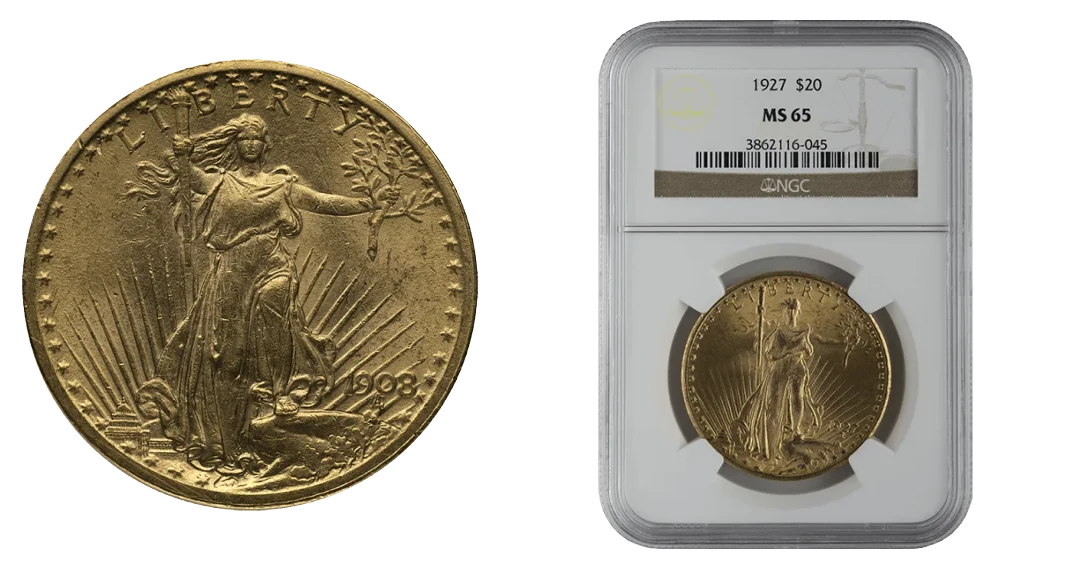
- Raw
- Certified
Authenticity. Counterfeit pre-1933 US gold exists in real volume. Some counterfeits are cast, some are struck from false dies, and some contain close to the right amount of gold, which means a simple weight or metal test does not settle the question. Deceptive counterfeits of popular types circulate steadily. A coin certified by NGC or PCGS has been examined by graders who see these types constantly.
Condition and originality. Many of these coins have been cleaned, polished, whizzed, or repaired at some point in the last century. Cleaning is often not obvious to an untrained eye and it substantially affects value. Certification identifies problem coins and states the issue on the label.
An agreed grade. With a coin in a sealed holder carrying a stated grade, a buyer and seller are working from the same description. That makes a raw coin harder to trade at full value than a certified coin, which is worth weighing before you sell.
Recognition beyond one counter. NGC and PCGS holders are read the same way by dealers, auction houses, and collectors nationwide, and the certification number can be verified online before anyone travels, ships, or wires money. A seller in Texas and a buyer somewhere else can work from a single description of the coin, which is not a small thing on material this often counterfeited.
Not every coin needs certification. Common-date circulated pieces trading near metal value often do not justify the expense. Anything that might be a better date, anything in unusually good condition, and anything you cannot confidently authenticate should be looked at.
Is pre-1933 gold IRA eligible?
This section is educational information only. It is not tax or legal advice. Texas Bullion Exchange does not provide tax or legal advice — talk to your own tax professional about your situation.
Generally no. The IRS requires gold held in a self-directed retirement account to be at least .995 fine, and pre-1933 US gold is 90 percent gold. Collectible coins are excluded from retirement accounts as a category, and these coins are collectibles by nature.
Buyers who want gold in a retirement account use modern bullion instead. Our overview of IRA-approved gold coins sets out what qualifies, and the ira-eligible entry explains the term. Be careful with any pitch that presents pre-1933 gold as a retirement product. Confirm eligibility with an IRA specialist and your own tax professional before moving money.
Handling and storage
Hold these coins by the edges, over a soft surface. Never clean them. Cleaning removes original surface and lowers value permanently, and there is no home method that improves a gold coin.
Store coins in inert holders, not in PVC flips, which break down over time and leave residue on the surface. Certified coins should stay in their holders. Keep the environment dry and stable, and keep an inventory with photographs for insurance.
If you have inherited a group of gold coins, the safest step is to do nothing to them until someone has looked at them. Our guide on selling inherited coins covers the sequence.
Owners who treat gold as something to hold for the long run sometimes ask what can sit alongside it. Texas Bullion Exchange runs a Principal Protection Program that locks in the original value of a qualifying gold position; whether any particular piece qualifies is a question for a specialist.
What an appraisal looks at
An appraisal of pre-1933 gold works through the coin systematically. Authentication comes first: weight, dimensions, design details, and the characteristics that separate genuine strikes from copies. Then denomination and design type, then date and mint mark, then condition, including whether the coin has been cleaned or repaired.
From there the appraiser separates common-date material that trades on gold content from pieces that need individual attention, and advises whether certification would be worth pursuing before sale. A good appraisal tells you which coins in a group are which, and explains the reasoning rather than just handing over a figure.
Get your coins appraised
If you have pre-1933 US gold and are not sure what is in the group, a proper look is the place to start. Texas Bullion Exchange offers free appraisals, and our staff work with these coins regularly enough to tell a common-date piece from something that deserves closer study. Call 855-344-2646 to speak with a Texas Bullion Exchange specialist or to arrange an appraisal.