
Reverse
The reverse is the back side of a coin. How reverse designs work on Morgan dollars, American Eagles, and pre-1933 US gold.
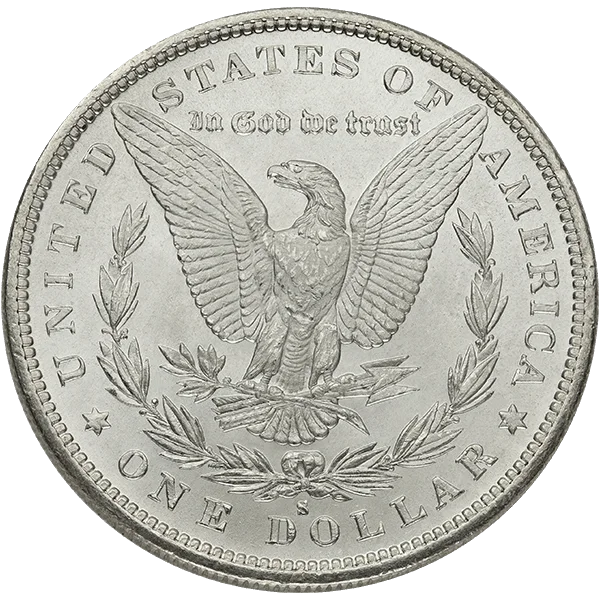
The reverse is the back side of a coin, the face opposite the obverse. Collectors and dealers use the term constantly, because the reverse is where much of a coin's identifying detail sits.
On the Morgan silver dollar, the reverse carries an eagle with outspread wings. It is also where the mint mark appears, below the wreath, which makes the reverse the side you check first when working out which facility struck a given Morgan. On pre-1933 US gold, the reverse of the Liberty Head double eagle shows a heraldic eagle, while the Saint-Gaudens type that followed it uses a flying eagle. Two coins of the same denomination can look entirely different on the reverse depending on the type.
Modern US Mint bullion follows the same pattern. The American Silver Eagle and the American Gold Eagle both carry eagle designs on the reverse, and the Gold Eagle reverse was changed in a later redesign of the series.
Condition matters on both sides. A grading service looks at the reverse with the same attention it gives the obverse, and marks on the reverse can hold a coin back from a higher grade.
If you are not sure what you are looking at on the back of a coin, a Texas Bullion Exchange specialist can identify it during a free appraisal.