
The American Gold Eagle: A Complete Guide
What the American Gold Eagle is, its 22 karat composition, the four sizes, bullion vs proof vs burnished, IRA eligibility, and how it compares.
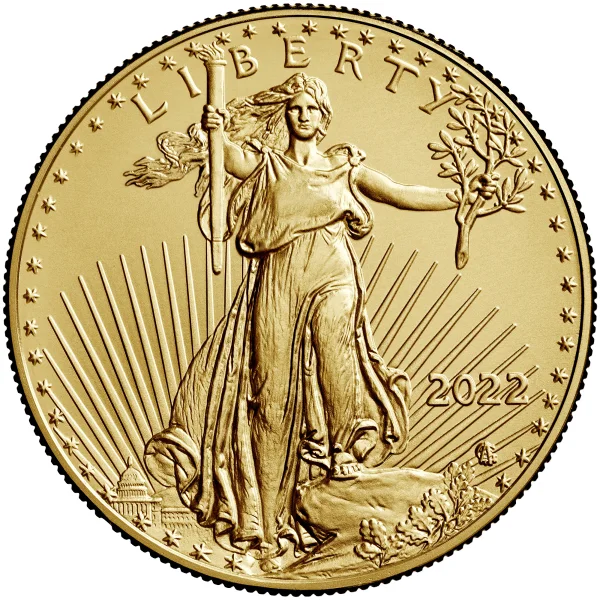
The American Gold Eagle is the official gold bullion coin of the United States. It is produced by the US Mint, it is legal tender, and its weight and purity are backed by the United States government. That government guarantee, combined with the fact that it has been produced continuously for decades, is the reason the Gold Eagle is the most widely traded gold coin in the American market.
For most buyers the practical point is simple. When you buy a one ounce Gold Eagle, you are buying one full troy ounce of gold in a form that any dealer in the country will recognize and quote on without hesitation.
What is the American Gold Eagle made of?
The Gold Eagle is a 22 karat coin, which works out to .9167 fine. The remaining alloy is silver and copper. That alloy is not filler and it is not a shortcut. Pure gold is soft enough that it marks easily, and a 22 karat coin holds up considerably better to handling, counting, shipping, and years in a safe deposit box.
The point that confuses people most often is the weight. A one ounce Gold Eagle contains one full troy ounce of pure gold. It does not contain one troy ounce of metal total. The silver and copper are added on top of the gold, so the finished coin weighs more than one troy ounce gross. The gold content is the number that matters when the coin is priced, and that number is a full ounce.
The same logic applies to the fractional sizes. A one-quarter ounce Gold Eagle contains a quarter troy ounce of gold and weighs somewhat more than that overall.
The four sizes and their face values
The Gold Eagle is issued in four sizes:
- One ounce, with a stated face value of $50
- One-half ounce, with a stated face value of $25
- One-quarter ounce, with a stated face value of $10
- One-tenth ounce, with a stated face value of $5
Those face values make the coins legal tender, which is a legal status rather than a description of what the coin is worth. No one spends a Gold Eagle at face value. The denomination exists because the coin is US coinage and coinage carries a denomination. The coin's market value tracks its gold content.
The size range is useful in practice. Larger pieces are the efficient way to hold a given quantity of gold. Smaller pieces give you the ability to sell a portion of a holding without liquidating a full ounce at once, which matters to some buyers more than the cost difference.
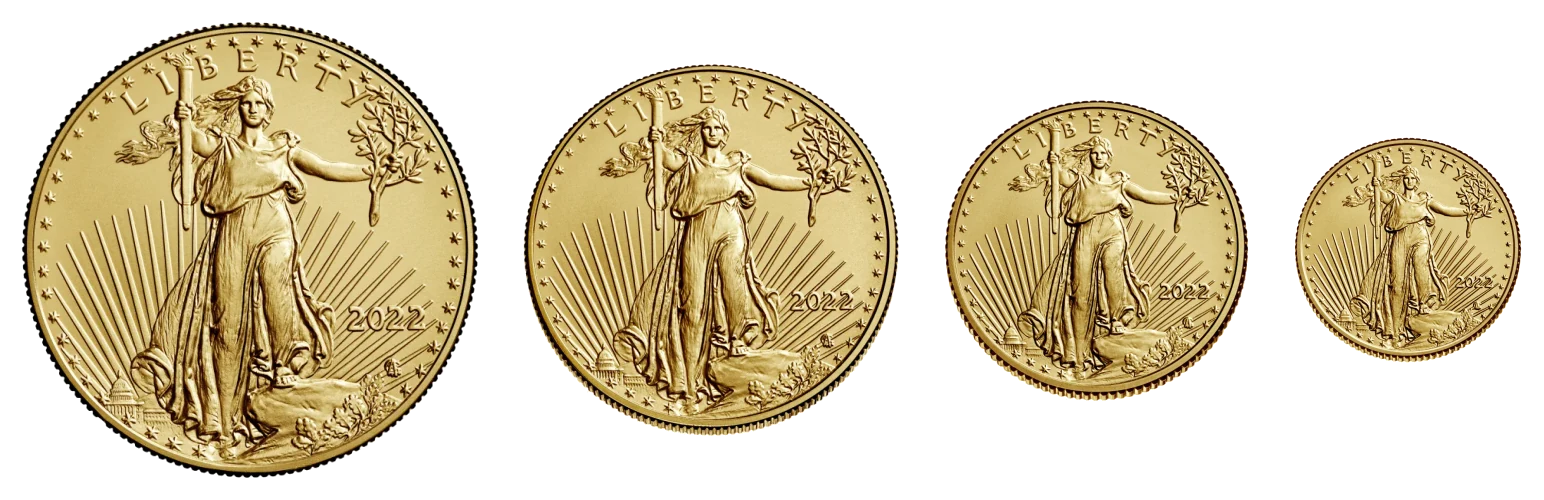
- 1 oz
- 1/2 oz
- 1/4 oz
- 1/10 oz
The designs on the Gold Eagle
The obverse carries a full-length figure of Liberty striding forward, holding a torch and an olive branch, with rays behind her. The design is adapted from Augustus Saint-Gaudens' work for the double eagle, widely regarded as the finest design ever placed on a United States coin. Putting that obverse on a modern bullion coin tied the new series directly to the classic era of American gold coinage.
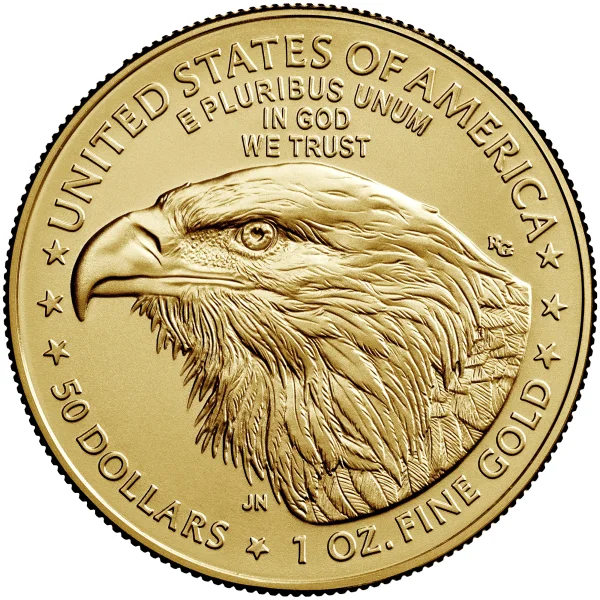
The reverse has always used an eagle motif. The original reverse showed a family group of eagles, with a male eagle carrying an olive branch to a nest holding a female eagle and hatchlings. In a later redesign the Mint replaced that scene with a close portrait of an eagle's head in profile.
Both reverse types are current legal tender and both trade on gold content. Buyers who care about the design usually have a preference; buyers holding metal generally do not sort by reverse type at all.
Bullion, proof, and burnished Gold Eagles
The Mint produces the Gold Eagle in three distinct product lines. They share the same weight and fineness, and they serve different buyers.
Bullion Gold Eagles are the standard product. They are struck for metal buyers, distributed through authorized purchasers rather than sold directly to the public by the Mint, and packaged in tubes and sealed boxes. The finish is a normal brilliant uncirculated strike. This is the product most people mean when they say they bought a Gold Eagle.
Proof Gold Eagles are struck for collectors using polished dies and specially prepared blanks, often with multiple strikes per coin. The result is a mirrored field with frosted raised devices, giving the design strong contrast. Proof coins are sold by the Mint in presentation packaging with a certificate of authenticity. A proof coin is a collector product first, and it carries a higher premium than a bullion coin of the same weight.
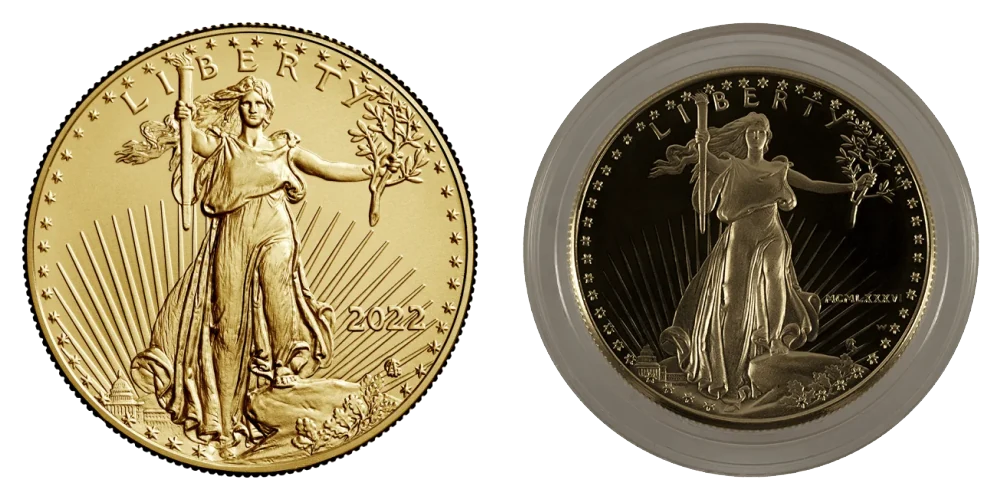
- Bullion
- Proof
Burnished Gold Eagles, sometimes called uncirculated collector Eagles, sit between the two. They are struck on burnished blanks with hand-fed presses, producing a softer matte surface rather than a mirror finish. They are sold individually in Mint packaging and are aimed at collectors who want a non-proof collector version of the coin.
If your goal is to own gold, the bullion coin is the direct route. If your goal is to build a set or you want the presentation piece, the proof and burnished issues are the ones to look at.
Is the Gold Eagle IRA eligible?
This section is educational information only. It is not tax or legal advice. Texas Bullion Exchange does not provide tax or legal advice — talk to your own tax professional about your situation.
Yes. The IRS sets a general fineness minimum of .995 for gold held in a self-directed retirement account, and the Gold Eagle at .9167 fine does not meet that threshold. It is admitted anyway, by a specific statutory exception written for American Eagle coinage.
The result is that the Gold Eagle is one of the most commonly held coins in gold IRAs, in both the one ounce and fractional sizes. Metal held in a retirement account must be held by an approved depository rather than at home, and account structure and custodian requirements vary. Our overview of IRA-approved gold coins covers what qualifies and what does not, and the ira-eligible entry explains the term. Confirm the specifics of your own situation with an IRA specialist and your tax professional.
Why do fractional Gold Eagles cost more per ounce?
A smaller coin costs more per ounce of gold than a larger one. The reason is production and handling rather than anything about the metal.
Each coin, regardless of size, takes a blank, a strike, inspection, and packaging. Producing ten one-tenth ounce coins requires ten times the operations of producing one ounce coin, for the same total gold. Distribution costs work the same way, since a dealer handles, counts, ships, and insures per piece.
That cost shows up as premium, the amount a coin sells for above the value of the metal in it. Premium rises as coin size falls, and it does so on every fractional bullion series, not just the Eagle. Our guide to gold premiums over spot explains how premium is set and why it moves.
The practical tradeoff: fractional coins cost more per ounce going in, and they give you finer control going out. Buyers who expect to sell in pieces often accept the tradeoff deliberately.
Buying and storing Gold Eagles
Buy from an established dealer who quotes clearly and stands behind what they sell. Gold Eagles are counterfeited, and the counterfeits have improved over the years. A dealer with proper testing equipment and long experience with the series is the practical defense for most buyers.
A coin bought already certified carries that check with it. NGC or PCGS examined the coin, confirmed it is genuine, assigned a grade, and sealed it in a tamper-evident holder under a certification number that anyone can look up online. Dealers, auction houses, and collectors across the country read those holders the same way, so the coin can be described and quoted without being sent anywhere first. On proof and burnished Eagles, where condition is most of what distinguishes one coin from the next, a graded example also settles what condition the coin is in before price is discussed at all.
Bullion Eagles are commonly sold in Mint tubes and sealed monster boxes. Buying sealed quantities is convenient and keeps the coins in good condition. Proof and burnished coins should stay in their original Mint packaging with the certificate, since removing them reduces what they bring on resale.
For storage, keep coins dry and handle them by the edges. Gold does not corrode, but the alloy surface can pick up fingerprints and hairlines. Home safes, safe deposit boxes, and third-party depositories all work, and the right answer depends on quantity, insurance, and how quickly you want access. Metal held in a retirement account has to go to a depository regardless of preference.
Keep your purchase records. They matter for insurance and for establishing cost basis when you sell.
Owners who expect to hold Gold Eagles for years rather than trade them often ask how the Principal Protection Program fits. It locks in the original value of a qualifying gold position, and a specialist can go through what qualifies.
Gold Eagle compared with the Gold Buffalo
The American Gold Buffalo is the other major US gold bullion coin. It is 24 karat, .9999 fine, one troy ounce of pure gold, with a design based on the classic Indian Head motif.
The choice between them comes down to two things.
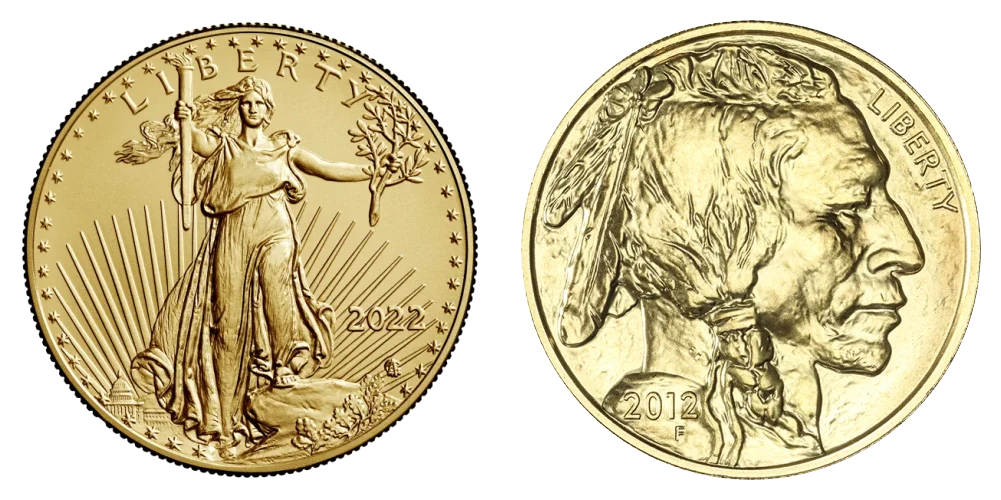
- Gold Eagle
- Gold Buffalo
Purity. The Buffalo is pure gold. Some buyers want that specifically, and a few overseas markets pay attention to .9999 fineness. Both coins contain a full ounce of gold, so purity is a question of composition rather than quantity.
Durability. The Eagle's 22 karat alloy resists marks and scuffs better than pure gold. A gold buffalo shows handling more readily, which matters if the coin will be moved, shipped, or handled at all.
The Eagle also has the longer record in the US market and the broader dealer familiarity, which shows up as easier resale. Both are IRA eligible and both are backed by the US government. Neither is a mistake.
Compared with foreign bullion coins
Sovereign mints outside the United States produce well-known gold bullion coins, including the South African Krugerrand, the Canadian Maple Leaf, the British Britannia, and the Austrian Philharmonic. All are legitimate coins from established mints, and all are traded in the US.
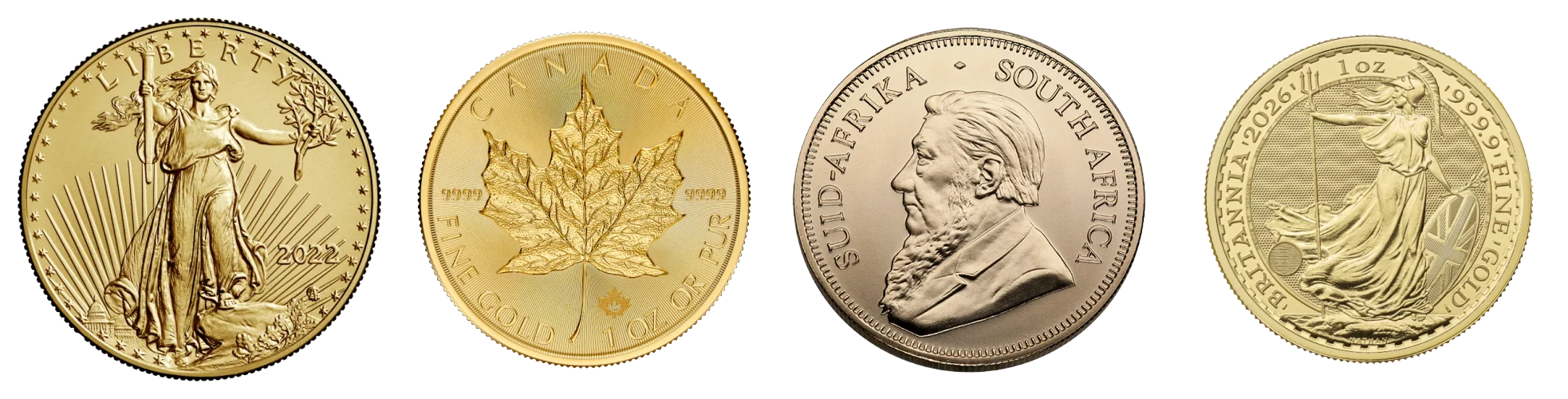
- Gold Eagle
- Maple Leaf
- Krugerrand
- Britannia
For a buyer in the United States, the Gold Eagle still has the practical advantage. It is the coin American dealers see most, quote most readily, and buy back with the least friction. It is guaranteed for weight and purity by the US government rather than a foreign one, and it is the coin most commonly accepted for retirement accounts. When it comes time to sell, recognition and liquidity in your own market are worth more than a small difference in fineness or design. For US buyers, the Eagle is the sensible default.
Talk to a specialist
If you are deciding between sizes, comparing the Eagle to the Buffalo, or figuring out how gold fits into what you already own, it helps to talk it through with someone who works with these coins daily. Texas Bullion Exchange staff can walk you through the options and quote current availability without pressure. Call 855-344-2646 to speak with a Texas Bullion Exchange specialist. Gold Eagles in all four sizes are also available through our online shop.