
Gold Premiums Over Spot, Explained
What the spot price is, what a premium covers, why it varies by coin and size, and how to compare two dealer offers on a per-ounce basis.
The premium is the amount a gold coin sells for above the market value of the metal inside it. Every coin from every dealer carries one, and it exists because raw metal in a vault and a finished, authenticated, recognizable coin in your hand are two different products. Understanding what the premium covers is the single most useful thing a buyer can learn about gold pricing.
What is the spot price, and what is it not?
The spot price is the going wholesale price for immediate delivery of unfabricated gold in the global market. It is a reference number set by trading in large, standardized quantities among institutions. It updates continuously through the trading week.
Three things spot is not.
It is not a retail price. No dealer anywhere sells finished coins at spot, because no one acquires finished coins at spot.
It is not the price of any particular coin. Spot describes metal. A coin is metal plus fabrication, plus a design, plus a legal tender status, plus a distribution chain.
It is not a price you can transact at. Spot reflects wholesale-scale transactions between counterparties who deal in bar-lot quantities and settle through established channels. It is a benchmark for pricing, not an offer.
What spot does do, and does well, is give buyers and sellers a shared reference. Both sides of a retail transaction can agree on where the metal market stands and then discuss the only part that is actually negotiable: the premium.
What goes into a premium?
The premium is not one charge. It is the accumulation of every cost between an ore body and a coin on a dealer's counter, plus the market's current appetite for that particular item.
Refining. Mined and recycled gold has to be refined to the fineness the finished product requires. Getting metal to .9999 fine for an American Gold Buffalo is more demanding than getting it to the 22 karat alloy used in the American Gold Eagle, and refining costs money at every step.
Blanking and minting. Refined metal is rolled to thickness, punched into blanks, annealed, and struck. Dies wear and must be replaced. Coins are inspected and rejected if they fail. All of this is manufacturing, and manufacturing has a cost per unit.
Mint markup. The US Mint does not sell its bullion coins at cost. It applies its own margin when it sells to authorized purchasers.
Distribution. The Mint sells bullion coins through a limited group of authorized purchasers, who sell onward to wholesalers and dealers. Each link in that chain carries inventory risk, hedging costs, and a margin.
Packaging, insurance, and shipping. Coins move in insured shipments, are stored in secured facilities, and arrive in tubes, monster boxes, or mint packaging. Insurance on precious metals in transit and in storage is a real recurring expense.
Dealer cost and margin. A dealer holds inventory, staffs a location, hedges price exposure on the metal it owns, processes payments, and answers the phone. The dealer's portion of the premium pays for all of that.
Supply and demand for the specific item. This is the part that moves. If retail buyers want one-ounce Eagles faster than the Mint and the distribution chain can supply them, the premium on that coin rises regardless of what gold itself is doing. If a product sits, its premium compresses.
That last component is why two coins containing the same amount of gold, on the same day, from the same dealer, can carry noticeably different premiums.
Why premium varies by product and size
Two structural factors explain most of the variation.
Fabrication cost per ounce of metal. Producing a coin involves fixed work that does not scale down with the metal content. A fractional coin takes broadly the same striking, inspection, handling, and packaging effort as a one-ounce coin but contains a fraction of the gold. Spread that fixed cost over less metal and the cost per ounce of gold rises. This is why fractional gold always carries a higher premium per ounce than one-ounce gold, everywhere, from everyone.
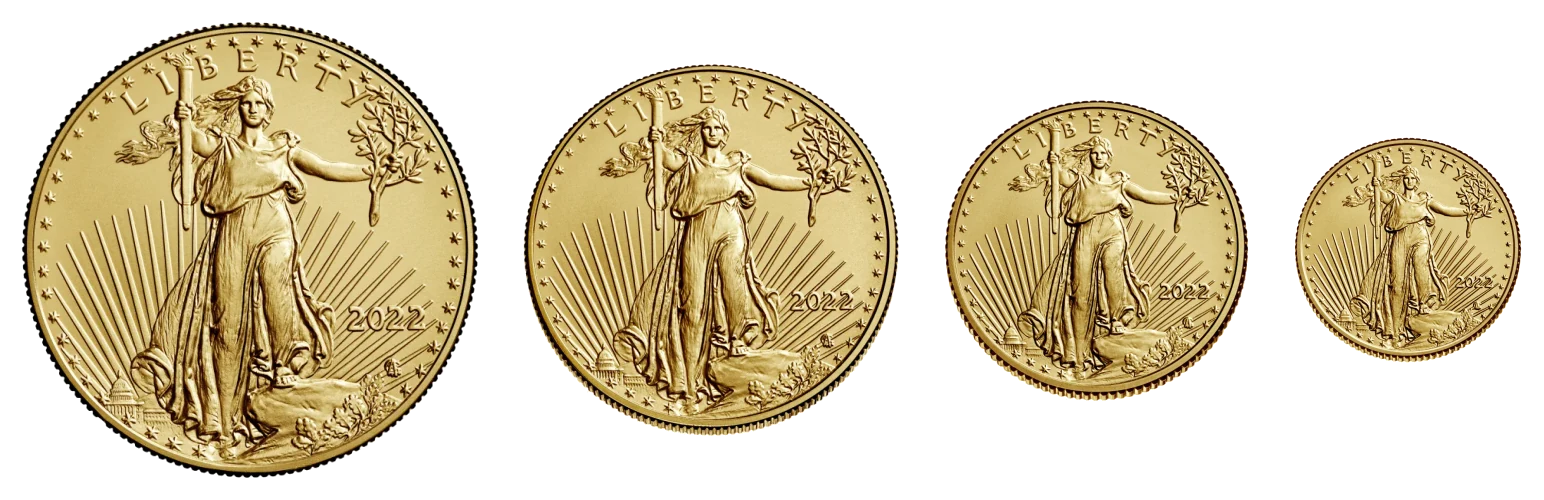
- 1 oz
- 1/2 oz
- 1/4 oz
- 1/10 oz
Liquidity and recognition. Products the market trades constantly carry tighter premiums because dealers can move them quickly and confidently. Products that are unusual, hard to authenticate on sight, or that appeal to a narrow group of buyers carry wider premiums, because the dealer holding them accepts more risk and a longer time to sell.
Historic material adds a third factor. Pre-1933 US gold is no longer produced. Its supply is fixed and finite, and its premium reflects collector demand and condition as well as metal, which makes it behave differently from current-production bullion.
Why proof and burnished coins carry higher premiums
The US Mint issues several finishes of the same coin, and they are not priced alike.
A bullion strike is produced for metal buyers. It is struck efficiently, in volume, to a good but ordinary standard of finish, and shipped in bulk packaging. Its premium is the lowest of the three.
A proof coin is a collector product. Blanks are polished, dies are specially prepared and frequently replaced, coins are struck more than once at reduced speed to bring up full detail, and each piece is handled individually and inspected. Proofs ship in a Mint presentation case with a certificate of authenticity. They are produced in far smaller quantities than bullion strikes.
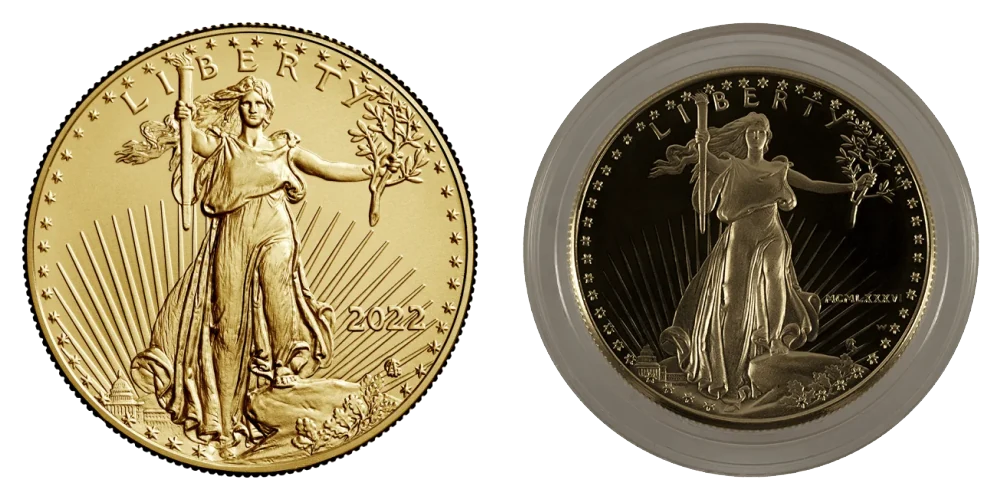
- Bullion
- Proof
Burnished coins, sometimes described by their uncirculated designation, sit between the two. The blanks are burnished before striking, giving a distinctive matte finish, and the coins are handled individually rather than in bulk. Production is limited and packaging is collector-oriented.
The higher premium on proof and burnished coins pays for that additional labor, that smaller production, and the collector market's demand for it. Whether it is worth paying depends entirely on why you are buying. If you want ounces of gold, the bullion strike delivers more metal for the money. If you are collecting US Mint issues, the proof is the product you want, and the premium is the price of admission. Buyers get into trouble only when they buy the collector product believing they bought the bullion product.
Buy premium versus buyback spread
Most buyers focus on the premium they pay and never ask about the other half of the transaction. The other half is what determines the real cost.
The buy premium is the amount above spot you pay to acquire the coin.
The buyback price is what a dealer will pay you for that same coin. Depending on the product and market conditions, a buyback may be above spot, at spot, or below it.
The distance between those two is the spread, and the spread is what the round trip actually costs you. A coin with an attractive buy premium and a poor buyback is a worse purchase than a coin priced slightly higher that a dealer will repurchase readily and close to what you paid.
Ask about buyback before you buy, not after. Any dealer who sells a product should be able to tell you what they would pay for it. A dealer who will not quote a buyback on their own inventory is telling you something about the product.
Spreads are generally tightest on the coins the market trades most heavily, which for US buyers means one-ounce American Gold Eagles and Gold Buffalos. Spreads widen on fractional sizes, on collector-finish product, and on anything unusual.
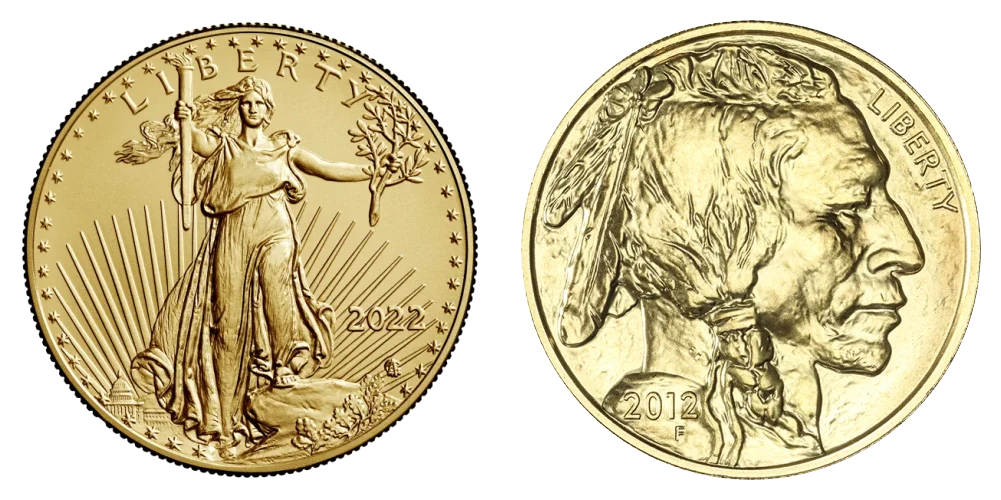
- Gold Eagle
- Gold Buffalo
Buyers who are already thinking about the far end of that round trip sometimes ask about the Principal Protection Program as well. It is a Texas Bullion Exchange program that locks in the original value of a qualifying gold position, and what qualifies is a conversation with a specialist rather than something to work out from a page.
Why the lowest premium is not automatically the best purchase
Premium is one input. A purchase decision has several.
- Liquidity. Can you sell it easily, to many buyers, without explaining what it is?
- Buyback. What will the dealer, and dealers generally, pay for it?
- Recognition. Will a buyer accept it on sight, or does it need authentication first? A coin already graded by NGC or PCGS arrives with that question settled, and its certification number can be checked online before either side commits.
- Availability. Is it in stock now, or is it a long backorder against a moving metal price?
- Counterparty. Is the dealer someone you can find, call, and visit?
- Fit. Does the size and form match what you actually intend to do?
A quoted premium that is well below the rest of the market usually has an explanation. Sometimes the explanation is benign: a dealer clearing inventory, or a promotional price on a small quantity. Sometimes it is a delivery delay, a payment method restriction, an item that turns out to be something other than what the headline suggested, or a poor buyback on the back end. The question to ask is not whether the number is low but why it is low.
How premiums behave when demand runs high
Premiums and metal prices are separate markets, and they do not always move together.
When retail demand surges, the constraint is usually not gold. It is the capacity to turn gold into finished coins and get them distributed. Refining capacity, minting throughput, and authorized purchaser allocation are all finite in the short run. Demand arrives faster than that chain can respond, available inventory is bid for, and premiums on the most sought-after products widen, sometimes substantially. Lead times stretch. Some products go on allocation or become unavailable at any premium for a while.
The reverse happens when demand cools. Inventory rebuilds, dealers who are long on product compete for buyers, and premiums compress back toward the level that ordinary production and distribution costs support.
Two practical consequences follow. First, buying into a demand spike means paying for both a metal price and an elevated premium, and the premium portion can retrace even if metal holds. Second, selling into a demand spike is the mirror image: buyback offers on scarce product improve when dealers cannot get inventory. Neither observation is a prediction. It is just how the premium component behaves, and knowing it exists separately from the metal price makes both sides of a transaction easier to read.
How to compare two offers
Comparing dealer quotes is straightforward if you standardize the comparison. Work in cost per troy ounce of actual gold content, all in.
- Identify the exact product. Same coin, same size, same finish, same year type if that matters, same certification status if any. A bullion strike and a proof are not comparable, and neither are a certified coin and a raw one.
- Get the total delivered cost. Include shipping, insurance, and the price for the way you will pay, since card and check or wire prices often differ. A quote that excludes those is not a quote.
- Divide by actual gold content, not gross weight. A one-ounce Gold Eagle weighs more than a troy ounce gross because it is 22 karat, but it contains exactly one troy ounce of gold. A $20 double eagle contains .9675 troy ounces. Compare on the gold, not the coin.
- Note the spot reference and the time. Two quotes taken hours apart are measured against different metal prices. Ask each dealer what spot they are quoting from so you are comparing premiums, not market moves.
- Ask each dealer for a buyback on the same item. Then compare spreads, not just buy prices.
- Confirm availability and lock terms. An in-stock item priced slightly higher may be a better outcome than a backordered item priced lower against an unlocked market.
Run through those six steps and the offers become directly comparable. Most of the time the differences turn out to be smaller than they first appeared, and the deciding factor is the buyback and the dealer rather than the headline price.
Talk to a specialist
Premium questions are easier to answer against a specific order than in the abstract. Texas Bullion Exchange staff can walk you through what a given coin costs today, what drives the premium on it, and what the buyback side looks like, so you can see both halves of the transaction before you commit. Call 855-344-2646 to speak with a Texas Bullion Exchange specialist. Current inventory is also listed online if you would rather look first.