
IRA-Approved Gold Coins: An Overview
Which gold, silver, platinum, and palladium coins qualify for a precious metals IRA, why collectibles do not, and how Eagles and Buffalos compare.
A coin qualifies for a precious metals IRA when it meets two conditions at once: it satisfies the minimum fineness set for its metal, and it was produced by a national government mint or by a refiner, assayer, or manufacturer meeting recognized accreditation standards. Coins that are collected for rarity or condition rather than metal content are excluded, even when they are made of gold. The American Gold Eagle is the notable exception to the fineness test, admitted by name.
This page is educational information only. It is not tax or legal advice. Texas Bullion Exchange does not provide tax or legal advice — confirm eligibility for any specific product with your IRA custodian and your own tax professional before buying.
The eligibility test in plain terms
Start with fineness. Fineness is the proportion of a coin that is the precious metal itself. The minimums are:
- Gold: .995 or finer
- Silver: .999 or finer
- Platinum: .9995 or finer
- Palladium: .9995 or finer
Meeting the number is necessary but not sufficient. The item also has to come from an acceptable source. A coin struck by a national government mint clears this on its own. A bar or round has to come from a refiner, assayer, or manufacturer holding the relevant accreditation, which is why generic privately made rounds are not automatically eligible even when the metal is pure enough.
The third filter is the collectible exclusion, discussed further below. A coin can be pure enough and from a government mint and still fail because of how it is treated in the market.
Custodians and depositories maintain their own approved product lists, and those lists are narrower than the outer boundary of what the law permits. The list your custodian works from is the one that governs your account. Ask for it in writing.
The American Gold Eagle exception
The American Gold Eagle is 22 karat, alloyed with silver and copper for durability. That works out to .9167 fine, which is below the .995 gold minimum. It is nevertheless IRA-eligible, because the statute names the American Eagle coins specifically rather than relying on the fineness threshold.
This matters because the one-ounce Gold Eagle still contains a full troy ounce of gold. The alloy adds gross weight rather than diluting the gold content, so the coin weighs more than one ounce overall while delivering an ounce of gold. Buyers sometimes assume the lower fineness means less metal. It does not.
The Gold Eagle is issued in multiple sizes. The fractional sizes are also IRA-eligible under the same exception, though they carry higher premiums per ounce of gold, which is worth weighing in a retirement account where the point is usually metal content per dollar. More on the series is in our American Gold Eagle guide.
The American Gold Buffalo
The American Gold Buffalo is the United States Mint's 24 karat gold bullion coin, struck at .9999 fine and containing one troy ounce of gold. It clears the .995 minimum comfortably and needs no exception.
Because it is pure gold rather than an alloy, the Buffalo is softer and marks more easily than an Eagle of the same size. That has no bearing on IRA eligibility and little bearing on value inside an IRA, where the coins sit in a vault rather than being handled. It matters more for coins held outside a retirement account. See the Gold Buffalo entry for the series background.
Proof coins in an IRA
Proof coins are struck by a distinct process with specially prepared dies and planchets, producing mirrored fields and frosted design elements. American Gold Eagle proofs, along with proofs of the other American Eagle coins, exist alongside the bullion versions.
Custodian practice on proofs varies. Some accept them, some restrict them, and some have packaging requirements of their own. Whether a particular proof coin can go into your account is a question for your custodian, and the answer you should rely on is the one they give you in writing.
There is a separate and more practical concern with proofs in an IRA. Proof coins carry substantially higher premiums than bullion strikes, because you are paying for the finish and the packaging as well as the gold. Inside a retirement account, where the objective is usually metal exposure, that premium is money that does not buy gold. Proofs have also been the vehicle in a number of aggressive IRA sales pitches, sold at prices well above ordinary bullion on the claim that they are somehow better suited to retirement accounts. They are not inherently better suited. If a salesperson is steering you toward proofs, ask directly what the premium is and why the bullion version will not do. A proof coin is a legitimate thing to own; it is just an expensive way to buy metal.
The other American Eagle coins
The Eagle program covers four metals, and all four are IRA-eligible under the same statutory naming.
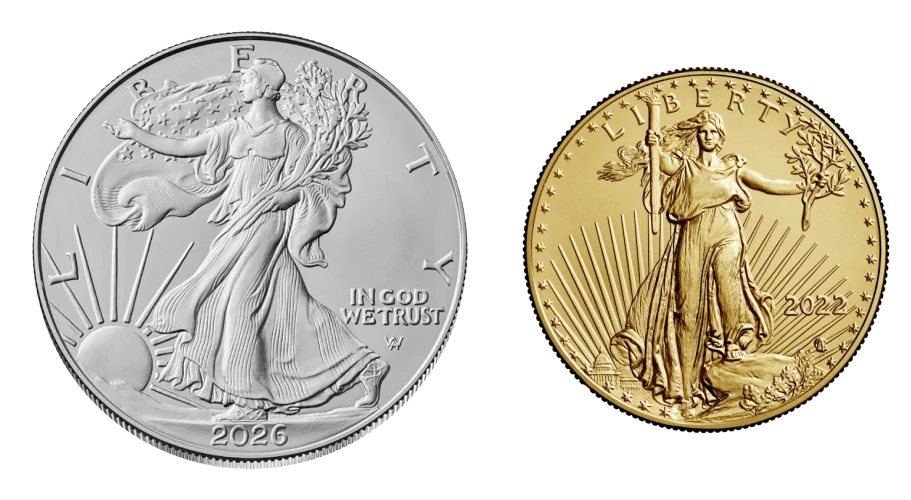
- Silver Eagle
- Gold Eagle
American Silver Eagle. One troy ounce of .999 fine silver with a $1 face value. It meets the silver minimum on its own terms and is the most widely traded silver bullion coin in the US market. See the Silver Eagle entry for details.
American Platinum Eagle. Struck in .9995 fine platinum, meeting the platinum minimum. Platinum is a thinner market than gold or silver, and both the buy and sell sides tend to have wider spreads.
American Palladium Eagle. Struck in .9995 fine palladium, meeting the palladium minimum. It is the newest of the four programs and the least liquid. Palladium pricing moves on industrial demand more than the other metals do, and the number of dealers making a market in it is smaller.
For most IRA holders, gold and silver make up the account and platinum or palladium appear as a smaller allocation, if at all. The narrower market is the reason, not any eligibility problem.
Why pre-1933 US gold and numismatic coins are excluded
The tax code prohibits IRAs from holding collectibles, and coins fall under that prohibition unless they qualify under one of the specific carve-outs for bullion and certain government-issued pieces. "Collectible" in this context does not mean anything a person happens to collect. It refers to items whose value derives from rarity, condition, historical interest, or desirability to collectors rather than from the metal they contain.
That is exactly the description of pre-1933 US gold. A $20 double eagle is 90 percent gold, which is .900 fine and below the .995 minimum, so it fails the fineness test outright. Beyond that, these coins trade on date, mintmark, and condition. Two double eagles with identical gold content can sell at very different prices because one is a common date and one is not. That price behavior is what makes them collectible, and it is what puts them outside an IRA.
The same reasoning excludes graded rarities, certified key dates, most commemoratives, and coins sold on the strength of their scarcity. Certification by a grading service does not make a coin IRA-eligible; if anything, a coin being sold on the basis of its grade is a signal that it is being valued as a collectible.
Be alert to sales pitches that blur this. Some operations sell high-premium graded coins into IRAs on the theory that a bullion-eligible coin in a slab is still bullion. The simpler approach is to hold plain bullion strikes in the IRA and keep collectible coins outside the account, where their nature is not a problem. Our gold IRA basics page covers the account mechanics behind this distinction.
Choosing between Eagles and Buffalos
Both are US Mint products, both are IRA-eligible, and both are liquid. The differences are modest.
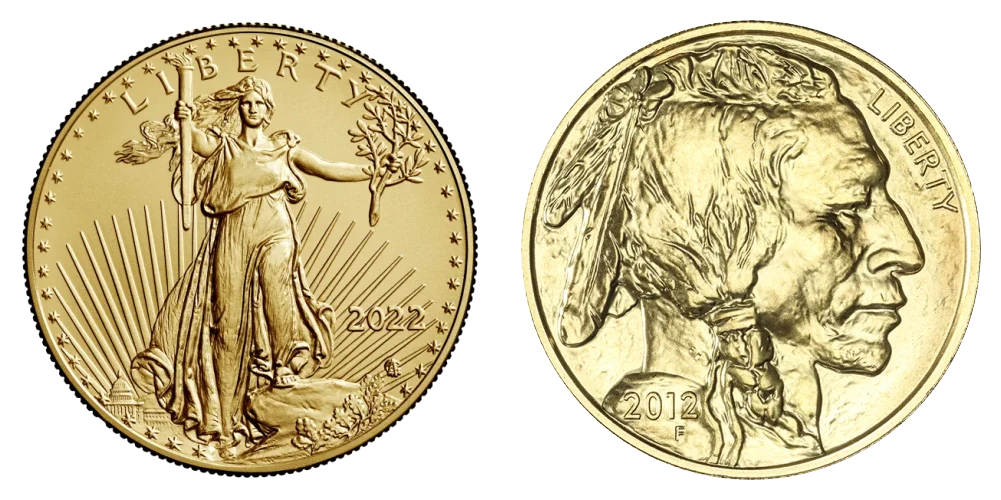
- Gold Eagle
- Gold Buffalo
| American Gold Eagle | American Gold Buffalo | |
|---|---|---|
| Purity | 22 karat, .9167 fine | 24 karat, .9999 fine |
| Gold content, 1 oz coin | One full troy ounce | One full troy ounce |
| Gross weight | Heavier than one ounce | One troy ounce |
| Durability | Alloyed, resists marking | Pure, marks more easily |
| Sizes | Multiple sizes offered | One ounce is the standard bullion size |
| IRA basis | Statutory exception | Meets .995 minimum |
In an IRA, durability is close to irrelevant because the coins go straight into a vault and stay there. What is left is premium and preference. Buffalos typically carry a somewhat higher premium than Eagles, though the relationship shifts with supply and demand. Some buyers want the purest coin available; others prefer the longer track record and larger circulating population of the Eagle. Neither choice is a mistake. Compare the premium on the day you buy and take the better value.
Compared with foreign IRA-eligible bullion
Several foreign government mints produce coins that meet the fineness minimums and are eligible for IRAs, including the Canadian Maple Leaf, the Austrian Philharmonic, and the British Britannia. Some custodians accept them; some do not. The South African Krugerrand is 22 karat like the Gold Eagle but has no statutory exception, so it does not qualify.
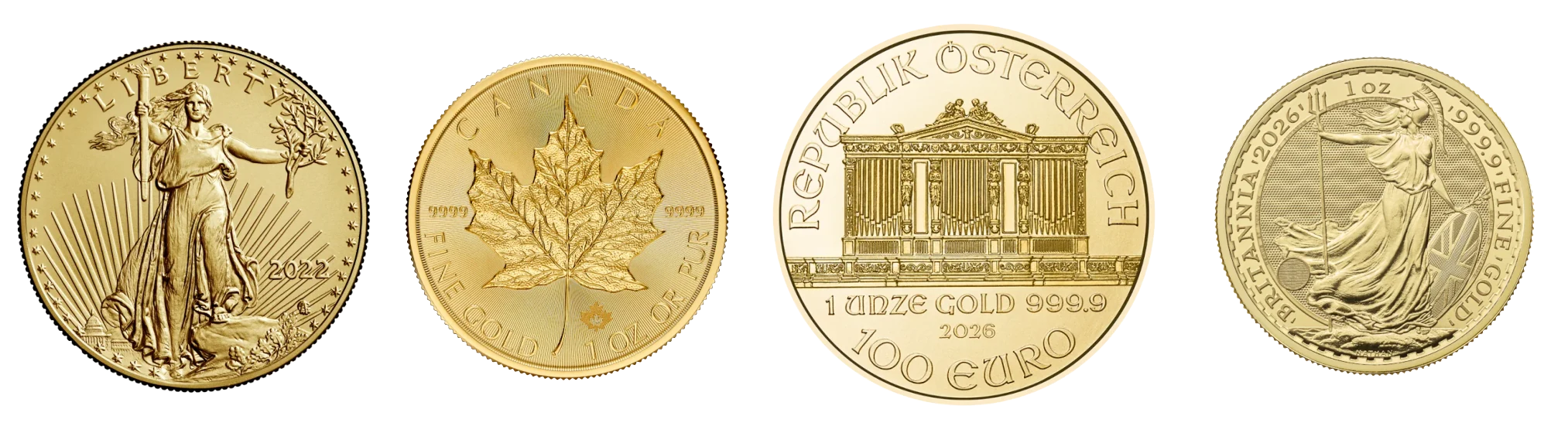
- Gold Eagle
- Maple Leaf
- Philharmonic
- Britannia
For an account held in the United States, US-minted Eagles and Buffalos have a practical advantage. They are the coins American dealers see every day, price most tightly, and buy back without hesitation. Depositories are set up to handle them, custodian approved-product lists always include them, and there is no question about recognition when the time comes to sell. Foreign bullion is legitimate metal, but it is one more variable in a transaction where you generally want fewer. Most IRA holders are better served by the domestic coins.
Why the coins ship straight to the depository
Metal owned by an IRA has to be held by an approved trustee or depository. The account owner cannot take possession of it. That is why the shipment goes from the dealer directly to the vault and never passes through your hands.
The sequence in practice: you select the products, the custodian pays the dealer from IRA funds, the dealer ships to the depository, the depository verifies the delivery and reports the holdings to the custodian, and you get a statement. Handling the coins yourself, even briefly, risks the metal being treated as distributed from the account. When you want the physical coins, you take an in-kind distribution and the depository ships them out under that process. What a distribution means for you is a question for your own tax professional.
Talk to an IRA specialist
Deciding which coins belong in a precious metals IRA is mostly a question of premium, liquidity, and what your custodian will accept. Texas Bullion Exchange staff can walk through the eligible products, quote the premium on each, and coordinate delivery to your depository. Call 855-344-2646 to speak with a specialist. This page is educational only and is not tax or legal advice — confirm the account and tax details with your own tax professional and your IRA custodian alongside your TBE specialist.