
The Morgan Silver Dollar: A Collector's Guide
What the Morgan silver dollar is, its designer and specifications, the five mints that struck it, VAM varieties, and how to start a collection.
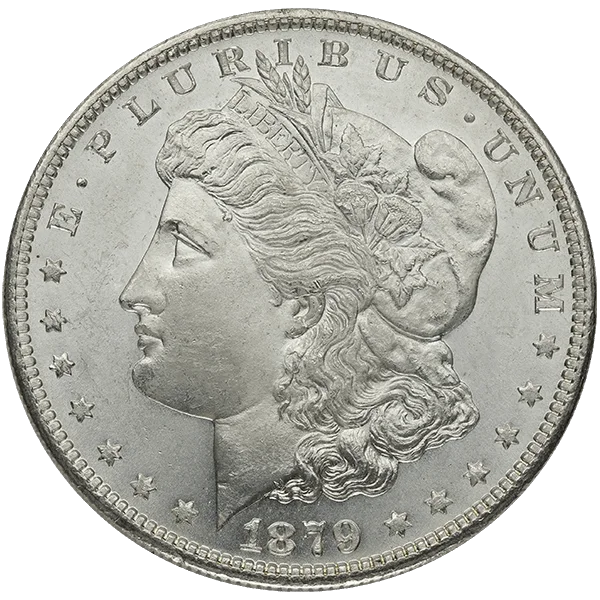
The Morgan silver dollar is a United States silver dollar designed by George T. Morgan, struck in 90 percent silver and 10 percent copper, weighing 26.73 grams with .7734 troy ounces of actual silver weight and measuring 38.1 millimeters across. It was produced across three separate periods at five different mints, and it is the most widely collected classic US silver dollar. Its combination of size, silver content, available dates and mintmarks, and documented die varieties gives it more entry points than almost any other American series.
Who designed it and what the design shows
George T. Morgan was an English-trained engraver who came to the Philadelphia Mint and later became Chief Engraver. The dollar carries his name because his initial M appears on both sides of the coin, on the truncation of Liberty's neck on the obverse and on the ribbon of the wreath on the reverse.
The obverse shows a left-facing head of Liberty wearing a Phrygian cap, with a headband inscribed LIBERTY and wheat and cotton in her hair. The wheat and cotton were a deliberate choice representing American agriculture, North and South. The legend E PLURIBUS UNUM arcs above, thirteen stars surround the portrait, and the date sits below. Morgan modeled the portrait on a live sitter rather than a classical bust, which is part of why the head reads as a specific person rather than an idealized figure.
The reverse shows an eagle with wings spread, clutching an olive branch in one talon and a bundle of arrows in the other. A wreath encircles the lower portion of the design. UNITED STATES OF AMERICA arcs above, IN GOD WE TRUST appears above the eagle, and ONE DOLLAR sits at the bottom.
Two reverse hub types exist across the series, differing in the number of tail feathers on the eagle. The change came early in production and the earlier type is separately collected.
The mints that struck it and where to look for the mintmark
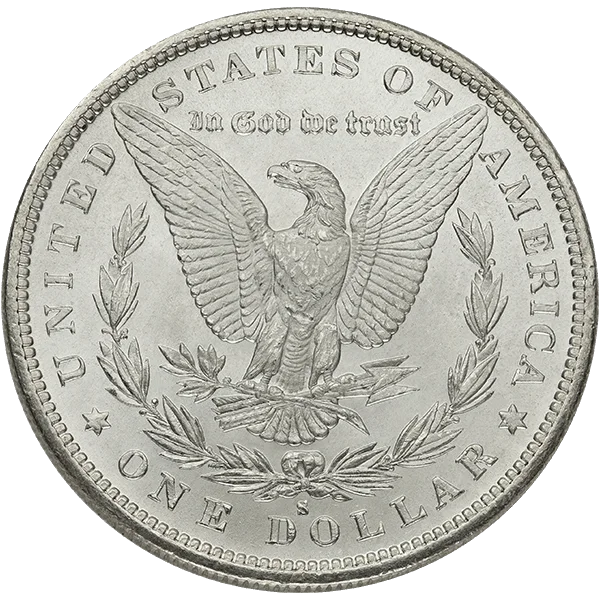
Five mints produced Morgan dollars. The mintmark is on the reverse, at the bottom of the design, below the wreath bow and above the space between the letters D and O in DOLLAR.
- Philadelphia — no mintmark
- New Orleans — O
- San Francisco — S
- Carson City — CC
- Denver — D
Denver's involvement was limited to the later resumption of production and did not extend across the main run.
Learning where the mintmark sits is the first practical skill for this series, because date and mintmark together define which coin you are holding. Two coins that look identical to the eye can be entirely different collecting propositions based on those two letters.
The production eras
The Morgan dollar was not struck continuously. It was produced in distinct periods separated by gaps, and knowing which period a coin belongs to explains a great deal about how it looks and how it survived.
The initial long run. The series began in the late 1870s and ran for a long stretch into the following decades, then paused. Production during this period was driven by federal silver purchase legislation rather than by public demand for dollar coins. Millions of pieces were struck, bagged, and stored in vaults, where many stayed for decades. That storage history is why so many surviving Morgans are unworn but heavily bag-marked: they never circulated, but they knocked against each other in canvas bags for a very long time.
The later resumption. After a gap of some years, production resumed briefly and then ended. Coins from this period were struck from new dies made under different conditions, and collectors generally treat the resumption issues as visually distinct from the earlier run. The Peace dollar replaced the Morgan shortly afterward.
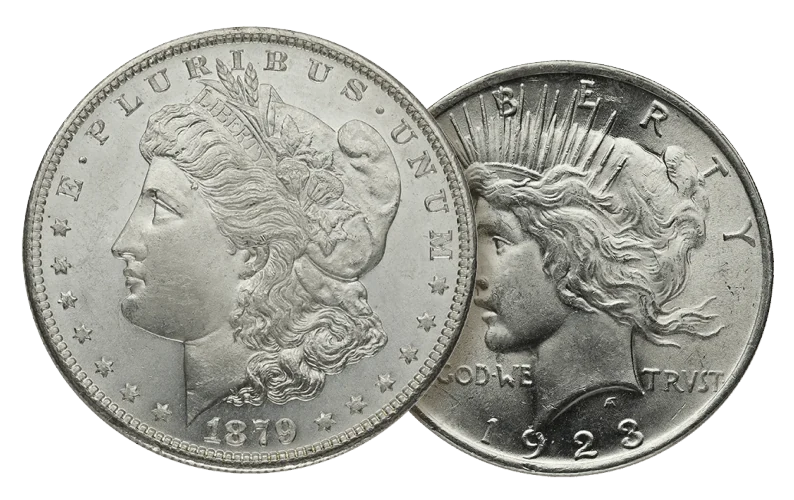
The modern revival. In recent years the United States Mint resumed striking Morgan dollars as collector products, alongside a matching Peace dollar. These are modern issues sold directly to collectors, not circulating coinage, and they are collected separately from the classic coins. They use modern silver specifications rather than the historical alloy, so do not assume a modern-issue Morgan matches the classic composition.
Why Carson City issues are collected
Carson City was a small mint built to serve the Nevada silver mining region. It operated for a limited number of years, was never a high-volume facility, and its output across all denominations was small compared with Philadelphia or San Francisco. The CC mintmark is therefore scarcer across the board than the other mintmarks in the series.
Beyond scarcity, the CC coins carry an association. They connect directly to the Comstock silver, to a frontier mint, and to a specific period in the American West. That story attracts buyers who are not otherwise series collectors, which broadens demand for the mintmark.
A further factor is how a portion of the surviving Carson City dollars reached the market. A large government-held quantity was eventually sold to the public in labeled holders through an organized sale, which put a recognizable, packaged version of the coin into circulation among collectors and gave the CC mintmark a public profile that other mintmarks never developed.
The practical consequence is that CC coins command more attention and more scrutiny than other issues, and they are also a more common target for altered mintmarks. That is a substantial argument for buying Carson City coins certified.
What VAM varieties are and why collectors care
Dies for Morgan dollars were made by hand-punching elements into working dies, and the process left small differences from die to die. A doubled date, a mintmark punched at an angle or in the wrong spot, a die crack that appears at a particular stage, a repunched letter — each of these identifies a specific die pair.
Leroy Van Allen and A. George Mallis catalogued these differences systematically and assigned each identified die combination a number. Those numbers are VAMs, and the reference system is now the standard language for Morgan and Peace dollar varieties. A coin described as a particular VAM is a coin struck from one documented die pairing.
Collectors care for several reasons. Some VAMs are dramatic enough to see without magnification and have acquired names of their own within the hobby. Some are scarce enough that the variety, not the date, is the reason to own the coin. And VAM collecting gives a way to specialize deeply within a single date, which appeals to people who have already assembled the basic set.
Attribution requires care. Many VAMs are distinguished by details that need magnification and a reference to confirm, and a misattributed coin is simply a common coin with a wrong label attached. When a variety is a meaningful part of what makes a coin desirable, an attribution from a grading service on the holder is worth having.
How condition drives desirability, and why certification matters here
Morgan dollars exist across the full width of the grading scale, from heavily worn pieces to coins that have never been touched. Because so many were stored in bags rather than circulated, the series has an unusually large supply of technically uncirculated coins with visible contact marks. The result is that the upper Mint State grades separate sharply: the difference between a well-marked uncirculated coin and a clean one is easy to see, and demand concentrates on the clean end.
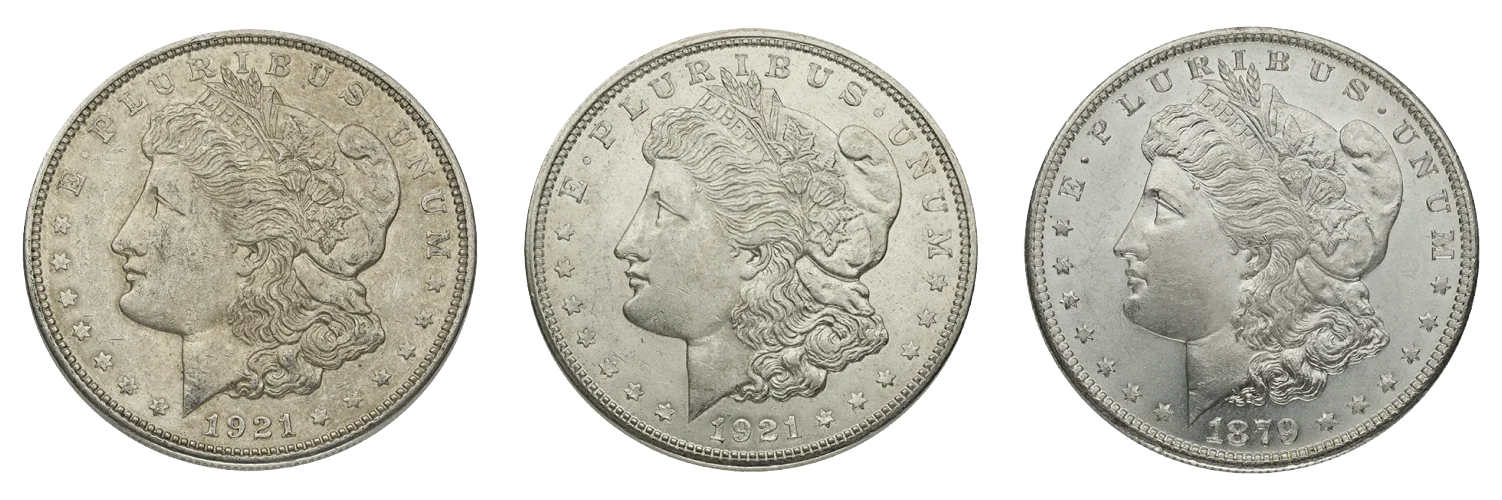
- Very Good
- About Uncirculated
- Brilliant Uncirculated
Several other factors specific to this series affect desirability. Strike quality varied considerably by mint and by period, and a softly struck coin shows weak detail in the hair above the ear and in the eagle's breast even though it never circulated. Some coins have deeply reflective fields from freshly polished dies, which grading services note with prooflike and deep mirror prooflike designations. Toning, developed over decades of bag storage, ranges from unattractive to highly sought after. Two coins carrying the same grade number can be quite different objects.
Certification does real work on this series for four reasons. It confirms authenticity, which matters because counterfeits and altered mintmarks exist, particularly for the scarcer combinations. It provides an independent condition opinion in a series where the grade meaningfully changes what a coin is worth. It detects cleaning, which is common on Morgans and permanently removes original surface. And it attributes varieties.
The holder keeps doing work after the grading is finished. It is tamper-evident, it keeps the coin from being handled, and the certification number stays attached to the coin, so the same description follows it to any dealer, auction house, or collector in the country instead of being argued out again at each counter. Our guide on raw versus certified coins covers when the expense is justified and when it is not; for common-date circulated Morgans, it usually is not.
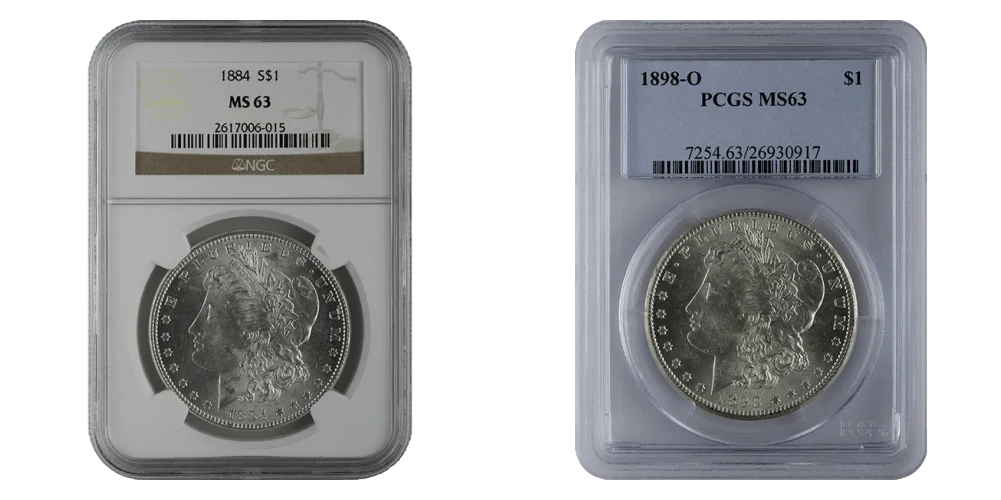
- NGC
- PCGS
For a working understanding of the numbers themselves, see the coin grading scale explained.
How to start collecting Morgan dollars
There are three usual approaches, and none is more legitimate than the others.
By date and mintmark. The traditional approach: one coin for every date and mintmark combination the series produced. It is a long project, it includes some genuinely difficult coins, and most collectors who attempt it work in a consistent grade range and fill the easier holes first. The advantage is a clear structure and a defined finish line.
By type or by a chosen subset. Some collectors want one good example of the design rather than all of them. Others build a smaller defined set: one coin from each of the five mints, or a run of Carson City issues, or a set of the resumption year. These projects finish, which is worth something.
By grade or by eye. Some collectors ignore completeness entirely and buy only coins that appeal to them, choosing for strike, luster, or toning. This approach requires more judgment and less bookkeeping, and it tends to produce a more interesting group of coins.
Whichever route you take, buy the best-preserved coin you can afford rather than filling a hole with a marginal example you will want to replace, learn what cleaned surfaces look like before buying anything unslabbed, and stay with certified coins for the scarce dates and mintmarks.
Care and handling
Silver dollars are durable but their surfaces are not. Original mint luster, once disturbed, does not come back.
- Hold coins by the edge, never by the faces. Fingerprints etch into silver over time.
- Never clean a coin. Cleaning removes original surface, is detectable to any experienced eye, and reduces desirability permanently. This is the most common and most costly mistake made with inherited silver dollars.
- Store in inert holders. Avoid PVC-containing flips, which break down and leave a residue on the coin.
- Keep humidity low and avoid storing coins near paper, rubber bands, or wood, which give off compounds that affect silver.
- Leave certified coins in their holders. Opening a slab discards the guarantee and the attribution along with it.
- If a coin looks like it needs conservation, take it to someone qualified rather than attempting anything yourself. Professional conservation is a specific service, not the same thing as cleaning.
Talk to a specialist about certification
If you have Morgan dollars and want to know what you have, whether any are worth certifying, or how to build a set without overpaying, the useful step is having someone examine them directly. Texas Bullion Exchange staff can go through your coins, explain where they fall on the grading scale, identify mintmarks and possible varieties, and advise on submission. Call 855-344-2646 to speak with a specialist or to arrange a free appraisal. Certified Morgan dollars are also available through our shop if you are buying rather than selling.