
The Coin Grading Scale Explained
How the 1-70 Sheldon grading scale works, what MS and PF mean, and how grades apply to Silver Eagles, Morgan dollars, and pre-1933 US gold.
Coin grading in the United States uses a numeric scale that runs from 1 to 70, where 1 is a coin worn nearly smooth and 70 is a coin with no flaws visible under magnification. The scale is called the Sheldon scale, and both major grading services use it. A grade is a statement about the physical condition of a specific coin, expressed as a number and usually a prefix such as MS or PF.
Understanding what those numbers describe makes it much easier to read a dealer listing, compare two coins of the same date, or decide whether a coin in your safe is worth sending in for certification.
Where the 1-70 scale came from
The scale originated in mid-twentieth-century American numismatics as a way to describe condition consistently rather than with loose words like "nice" or "sharp." It was originally developed with a particular US series in mind and was later extended, adapted, and formalized by the third-party grading services into the general-purpose system used today.
The original concept tied the numbers to relative value, but that relationship did not hold up over time and is not how the scale functions now. Today the number describes condition only. The market decides what any given condition is worth, and that changes with demand.
What survived is the range itself. Everyone in the US market, from auction houses to retail dealers, works from the same 1 to 70 framework, which is the reason the Sheldon scale is worth learning even if you never submit a coin for grading.
Circulated grades versus Mint State
The single most important division on the scale is between coins that circulated and coins that did not.
A circulated coin has wear. It was handled, spent, stored loose, and lost metal from its high points. Circulated grades occupy the range from 1 up to 58. Within that range, a grader is mostly judging how much design detail remains and how sharp the remaining detail is.
A Mint State coin never circulated. It has no wear at all, though it may have contact marks from striking, handling in bags, or the coining process itself. Mint State grades occupy 60 through 70. Within that range, a grader is no longer asking how much detail survives, because all of it does. The question becomes how clean the surfaces are and how well the coin was made.
The jump from 58 to 60 is a category change, not a small step. A coin at the top of the circulated range can be more attractive to the eye than a coin at the bottom of Mint State, because a lightly rubbed coin with clean fields may look better than an unworn coin covered in bag marks.
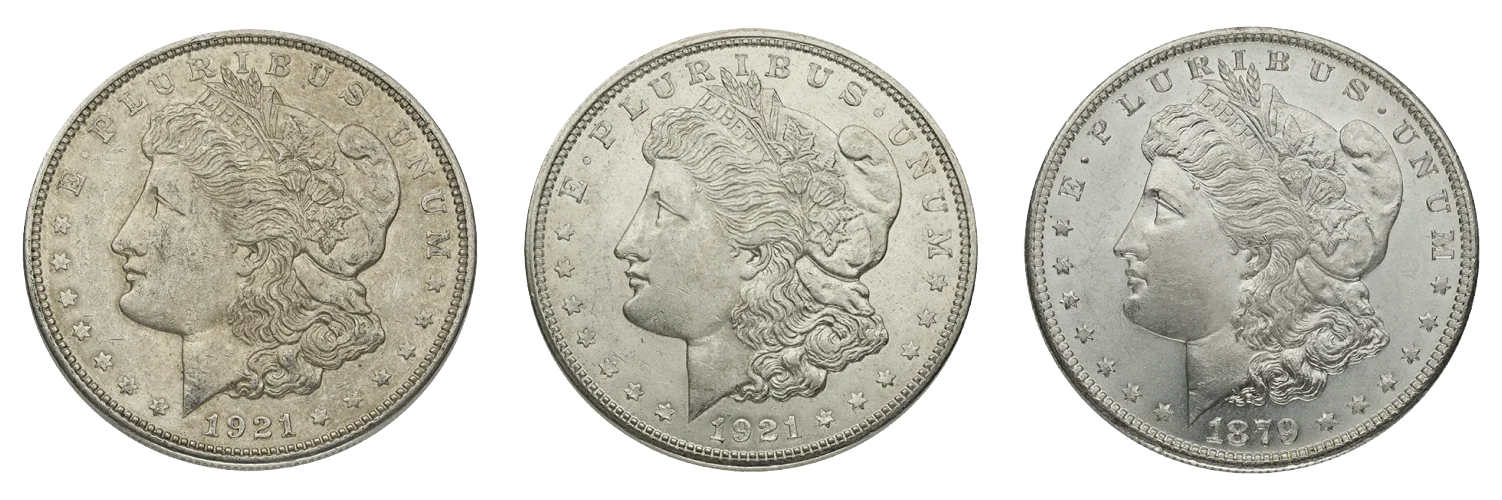
- Very Good
- About Uncirculated
- Brilliant Uncirculated
What the sub-ranges describe
Circulated grades are grouped into named bands. Each band has numeric grades inside it, and the descriptions below are qualitative rather than mechanical.
- Good — Heavy wear. The design is outlined and the major features are identifiable, but interior detail is largely gone. The rims may be worn into the lettering.
- Very Good and Fine — Moderate to considerable wear. Major design elements are clear and some interior detail returns. On a Morgan dollar this is roughly where hair and feather detail begins to reappear rather than being a flat surface.
- Very Fine and Extremely Fine — Light to moderate wear confined mostly to the high points. Most detail is present and sharp. Extremely Fine coins still show clear separation in fine design elements.
- About Uncirculated — Wear so slight it takes angled light to find. Traces of the original mint finish usually remain in protected areas. This band sits directly below Mint State and is where careful examination matters most.
- Mint State — No wear whatsoever. Grades run from 60, where the coin is unworn but heavily marked, up to 70, where nothing distracting appears even under magnification.
What MS, PF, and SP mean
The letters before the number tell you how the coin was made.
MS means Mint State. It is used for coins struck by ordinary production methods and never released into circulation. A Silver Eagle pulled straight from a mint tube is a candidate for an MS grade.
PF means Proof. Proof coins are struck by a distinct process using specially prepared dies and planchets, generally with multiple strikes, producing mirrored fields and frosted devices. Proof is a method of manufacture, not a grade by itself, which is why a proof coin still receives a number from 60 to 70. Some services abbreviate it PR rather than PF; the meaning is the same.
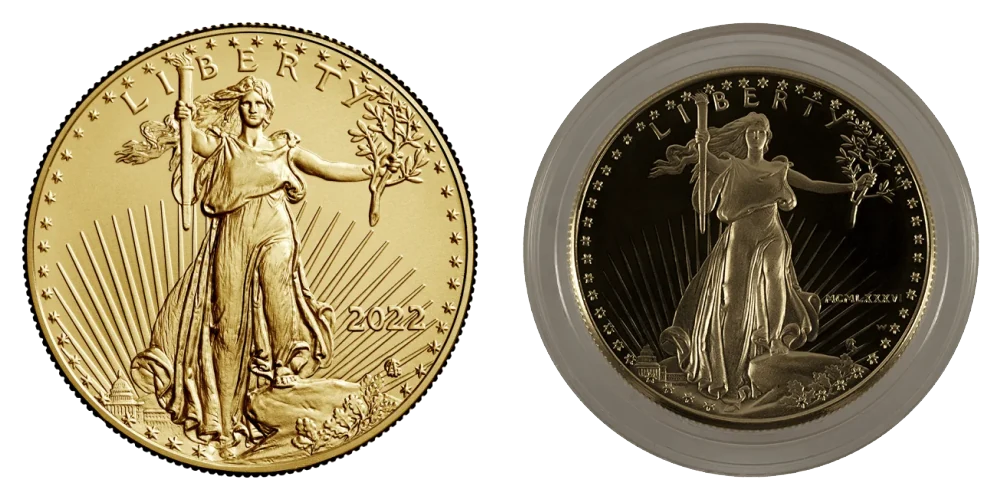
- Bullion
- Proof
SP means Specimen. It is applied to coins that are neither ordinary production strikes nor full proofs. Burnished and certain special-finish US Mint issues often fall here.
You may also see PL and DPL or DMPL designations on certain classic silver dollars, indicating reflective fields. Those are surface descriptions layered on top of a Mint State grade, not separate grades.
The four things a grader assesses
Graders evaluate a coin along four dimensions and then arrive at a single number that reflects the whole.
- Strike — How completely the design transferred from die to planchet. A weakly struck coin shows soft detail in the areas that required the most metal flow, even though it never circulated. Strike quality is a manufacturing outcome, not damage.
- Luster — The way light moves across the surface, produced by the flow lines created during striking. Original luster is difficult to fake and easy to destroy. Cleaning removes it, and once gone it does not come back.
- Surface preservation — The count, size, and location of contact marks, hairlines, spots, and other disturbances. A mark in an open field on the obverse hurts more than the same mark hidden in the design.
- Eye appeal — The overall impression, including toning and how the other three factors combine. Two coins can share the same technical characteristics and land differently because one is simply more attractive.
Eye appeal is the reason two coins in the same grade can trade differently. It is also the reason experienced buyers look at the coin rather than only the number on the label.
Why one point matters more at the top
Between grades in the circulated range, the difference is a visible amount of wear that most people can see once it is pointed out. The market treats those steps as gradual.
Near the top of Mint State, the steps compress. The difference between a 68 and a 69 may be a single small mark that requires magnification to find. The difference between 69 and 70 may be nothing you can see with the naked eye at all. Yet demand concentrates heavily at the top, because buyers in that part of the market are specifically buying the absence of imperfection. Small physical differences translate into large differences in desirability, which is why MS70 is treated as its own category rather than just one notch above 69.
This compression also means grading at the top is genuinely difficult and somewhat subjective. Reasonable graders can disagree, and the same coin submitted twice may not always come back identically.
How the scale applies to modern bullion versus classic coins
The numbers mean the same thing across all US coins, but they behave very differently depending on what is being graded.
Modern US Mint bullion, including Gold Eagles and Silver Eagles, is struck on modern presses, handled carefully, and packaged for shipment. High Mint State grades are attainable in normal production, and the meaningful distinctions occur in the narrow band at the very top of the scale. For a buyer holding these coins primarily for metal content, the grade is often beside the point, since the coin's bullion value does not depend on certification. Grading matters when the goal is collecting a top-condition example rather than accumulating metal. Our American Gold Eagle guide covers how those two motives differ.
Classic US coins behave in the opposite way. Morgan dollars circulated, were stored in bags, and moved through decades of handling. Most surviving examples carry wear or bag marks, so the full width of the scale gets used, and the upper Mint State grades are genuinely scarce for many dates. The same is true of pre-1933 US gold, where coins were used as money and stored in bulk. For these series, the difference between an About Uncirculated coin and a solid Mint State coin is substantial, and certification does real work.
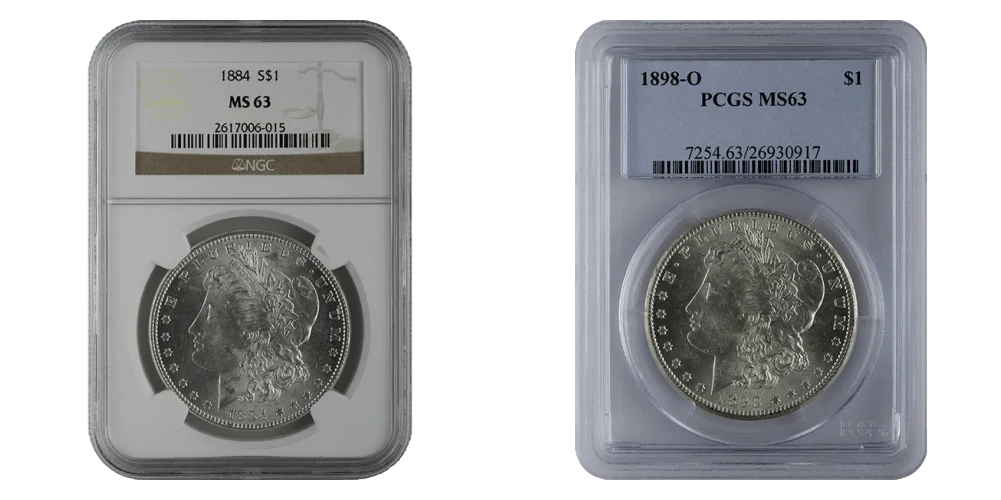
- NGC
- PCGS
That work outlasts the grading itself. Once an independent service has authenticated a coin, put a number on it, and sealed both into a labeled holder under a certification number, later buyers are not being asked to take anyone's word for where the coin falls on the scale. They can read the label, look up the number, and see that the holder has not been opened.
Plus grades, stars, and designations
Beyond the base number, services add modifiers.
A plus indicates a coin at the high end of its assigned grade, close to but not quite at the next number up. A star typically flags exceptional eye appeal within the grade. Designations such as those noting cameo contrast on proofs, or strike-related qualities on specific series, describe a particular characteristic rather than raising or lowering the grade.
These modifiers are useful shorthand, but they are secondary. A coin's base grade, and how the coin actually looks in hand, remain the primary considerations. The differences between how each service applies these markers are covered in NGC versus PCGS.
Talk to a specialist
If you have coins and are unsure how the scale applies to them, the most useful step is to have someone look at them directly. Texas Bullion Exchange staff can walk through what you have, explain where it likely falls on the scale, and tell you whether certification is worth pursuing. Call 855-344-2646 to speak with a specialist or to arrange a free appraisal. Certified coins are also available through our shop if you prefer to buy already graded.