
NGC vs PCGS: How the Two Grading Services Compare
An even-handed look at NGC and PCGS: how submission works, how holders and labels differ, where CAC fits, and what actually matters to a buyer.
NGC and PCGS are the two most widely recognized third-party coin grading services in the United States. Both authenticate coins, assign a grade on the same 1-to-70 scale, and seal the coin in a tamper-evident holder with a label. Coins in either holder are broadly accepted by US dealers, auction houses, and collectors.
The practical answer for most buyers is that both are trustworthy and the choice between them rarely determines whether a purchase is a good one. What follows is what actually differs, and what matters more than the difference.
What the two services have in common
Both operate on the same basic premise. A coin arrives, a grader who does not own it and has no stake in its sale examines it, and the result is recorded in a way that cannot be quietly altered afterward.
Both use the Sheldon scale from 1 to 70, with the same structure of circulated grades below 60 and Mint State grades from 60 up. Both use MS for Mint State, PF or PR for proof strikes, and SP for specimen and special-finish issues. Both grade the full range of US material, from pre-1933 gold and Morgan dollars to current-year American Eagles.
Both also offer a guarantee. The specific terms differ and change over time, but the general shape is the same: the service stands behind the authenticity of the coin and behind the grade it assigned, and provides a remedy if a coin in an intact holder is later shown to be misattributed.
What a submission actually involves
Submitting a coin is a defined process rather than a favor. Conceptually, it has four parts.
- Authentication. The service confirms the coin is genuine and correctly attributed to a date, mint, and variety. This step is the reason certification exists. A counterfeit does not receive a grade.
- Grading. Multiple graders independently assess the coin and a grade is finalized. Graders evaluate strike, luster, surface preservation, and eye appeal, as described in our grading scale guide.
- Encapsulation. The coin is sealed in a rigid plastic holder, commonly called a slab, with an insert showing the description, grade, and a unique certification number.
- Registration. The certification number is entered into the service's database so anyone can look it up later.
Submissions generally go through a dealer or a paid membership, and there are published fees that vary with the coin's value and the turnaround time selected.
Coins that fail authentication are returned. Coins that are genuine but have a problem serious enough to prevent a straight grade, such as cleaning or damage, are usually encapsulated with a details notation instead of a number.
Holders, labels, and lookups
This is where the visible differences sit. The table below covers the general character of each service's presentation rather than exact specifications, which change with successive holder generations.
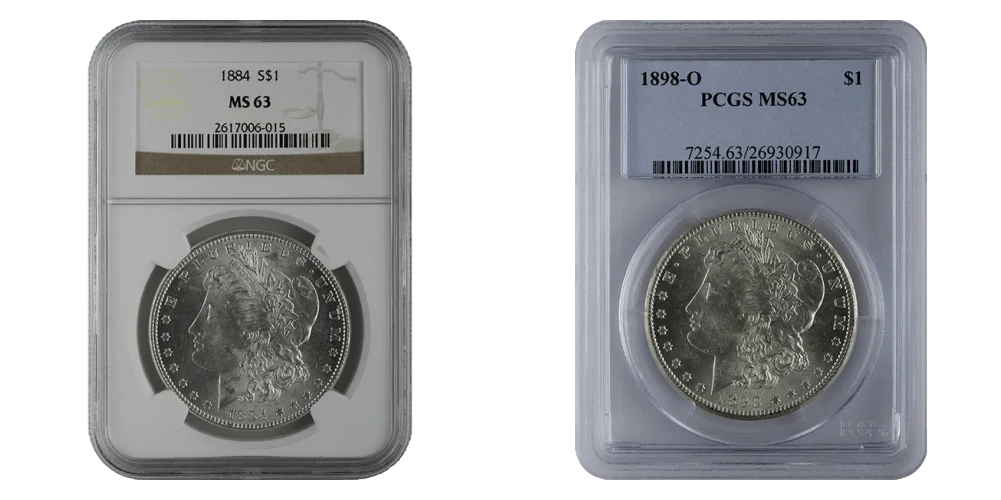
- NGC
- PCGS
| NGC | PCGS | |
|---|---|---|
| Holder | Rigid clear holder with an internal core that frames the coin | Rigid clear holder with the coin held in an internal ring |
| Label position | Insert at the top of the holder | Insert at the top of the holder |
| Label variants | Standard, plus a range of special and commemorative label styles | Standard, plus a range of special and commemorative label styles |
| Certification number | Unique number tied to an online lookup | Unique number tied to an online lookup |
| Verification | Online cert lookup returning the coin's description and grade | Online cert lookup returning the coin's description and grade |
Both services have redesigned their holders more than once, and both incorporate security features intended to make counterfeit slabs harder to produce. Counterfeit holders do exist. The certification lookup is the practical defense: check the number, and confirm the returned description matches the coin you are holding. If a listing shows a slab but the certification number is obscured, that is worth asking about.
Neither holder is inherently better protection. Both are sealed, both are rigid, and both will keep a coin from being handled. Both are also tamper-evident, which is the point of encapsulating a coin in the first place: an intact holder is evidence that the coin inside is still the coin the service examined and graded.
Designations each service is known for
Beyond the base grade, each service applies modifiers.
NGC is commonly associated with a star designation, used to indicate exceptional eye appeal within an assigned grade. PCGS is commonly associated with a plus, indicating a coin at the high end of its grade. In practice both services have added modifiers over time and the exact current set for each should be checked against the service's own published standards rather than assumed.
Both also offer early-release style labels for coins submitted within a defined window after a new issue is released. These carry different names at each service. It is worth understanding what such a label does and does not claim. It reflects when the coin was submitted, not anything about how or when the coin was struck, and it does not affect the grade. Our note on first strike labels covers this distinction.
Series-specific designations also exist, including notations for reflective surfaces on classic silver dollars and cameo contrast on proofs. These describe a characteristic of the coin rather than changing its grade.
Where CAC fits
CAC operates alongside NGC and PCGS rather than competing with them on the same task. It does not assign the original grade. It evaluates coins already graded by the two major services and indicates whether, in its assessment, the coin is solid or better for the grade it carries.
The reason it exists is that grading has range within it. Two coins can both legitimately hold the same grade while one sits at the low edge and the other at the high edge. A CAC evaluation is a second opinion on where within the grade the coin sits.
CAC's focus has historically been classic US coins rather than modern bullion. For someone buying current-issue American Eagles, it generally does not come up. For someone buying a Morgan dollar or a pre-1933 gold piece in a competitive grade, it is part of the landscape. CAC has also moved into grading and encapsulating coins in its own holders, which is a newer development.
What actually matters to a buyer
Three things, in roughly this order.
The coin, not the holder. Within any single grade there is a range. A coin at the top of MS64 can be more attractive and more desirable than one at the bottom of MS65. Looking at the coin, or having someone experienced look at it, tells you more than the service name.
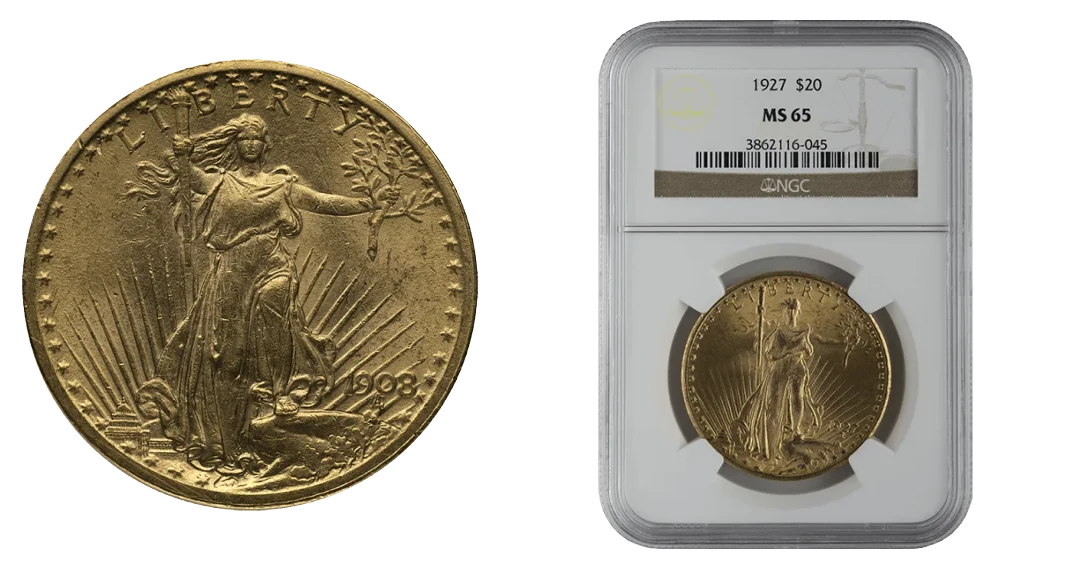
- Raw
- Certified
Eye appeal within the grade. Toning, luster, strike quality, and where the contact marks fall vary enormously among coins carrying identical grades. This is what separates coins that sell readily from coins that sit.
Acceptance. Both NGC and PCGS holders are accepted throughout the US market, by retail dealers, auction houses, and collectors alike, and both certification numbers can be verified online from anywhere. A dealer buying your collection will not refuse one because of the brand. There are corners of the market where collectors have strong preferences, particularly among registry set participants who build sets within a single service's framework, but that is a collector preference rather than a statement about grading accuracy.
Crossing coins between services
Coins can move from one service's holder to the other's. Both accept crossover submissions, where you send in a coin still sealed in a competitor's holder and ask that it be regraded and reholdered.
Crossing is not automatic. The receiving service grades the coin on its own judgment and may assign a different grade. Standard practice is to specify a minimum acceptable grade. If the coin would not meet that minimum, it comes back untouched in its original holder. Setting a minimum equal to the current grade means the coin either crosses at the same number or does not cross at all.
Whether crossing is worth it depends on why you are doing it. If the goal is a registry set that requires one service, it may be. If the goal is a better grade, it is a gamble, and the coin can also come back lower. For a coin you intend to sell in the near term in either holder, there is usually no reason to bother.
Talk to a specialist
If you are deciding between two graded coins, or wondering whether a coin you own would benefit from certification or a crossover, it helps to have someone examine it rather than reason from the label alone. Texas Bullion Exchange staff can review what you have and give you a straight assessment. Call 855-344-2646 to speak with a specialist. Certified coins in both NGC and PCGS holders are also listed in our shop.