
Sales Tax on Precious Metals in Texas
Texas does not impose state sales tax on precious metals. What that general rule means for gold and silver buyers, and where to take the questions a dealer cannot answer.
This page is educational information only. It is not tax or legal advice. Texas Bullion Exchange does not provide tax or legal advice — for anything touching your own situation, talk to your own tax professional.
Texas does not impose state sales tax on precious metals. For a buyer of gold or silver, that means the transaction is priced on the metal and the premium rather than on the metal, the premium, and a tax line on top. It is one of the practical reasons Texas is a straightforward state in which to buy and hold physical metals.
That is the general rule. The rest of this page explains what it covers in general terms, and where you should stop reading a website and talk to a professional instead.
What the general rule means
Sales tax is a transaction tax. It is assessed at the point of purchase, collected by the seller, and remitted to the state. When a state exempts a category of goods from sales tax, purchases in that category are simply not charged it.
Texas treats precious metals as an exempt category. That is the general rule, and it is as far as this page goes. The specifics underneath it — what qualifies, and how any of it applies to a particular order — are not things a website should be answering. Those come from the state, from your own tax professional, or from the dealer handling the order in front of you.
Why this matters to gold and silver dollar buyers
Precious metals are a low-margin purchase relative to their price. The gap between what a coin costs and what it is worth as metal is narrow by design, which is a large part of the appeal. A transaction tax applied on top of a purchase like that is not a small rounding item. It is a meaningful cost added at the moment of purchase, and it has to be recovered before the position breaks even.
The absence of a state sales tax charge in Texas removes that consideration from the buying decision. Practically speaking, it means a few things.
- Pricing is easier to compare. What you are weighing is the premium over spot, not premium plus a tax layer.
- Buying in stages is less penalized. Buyers who add to a holding gradually rather than in one purchase are not paying a transaction charge on each installment.
- The buy-and-sell round trip is cleaner. The cost of getting in and out of a position comes down to the dealer spread rather than the spread plus a tax paid at entry.
This applies across the in-scope range: American Gold Eagles, Gold Buffalos, pre-1933 US gold, American Silver Eagles, Morgan and Peace dollars, and US Mint proof and commemorative product.
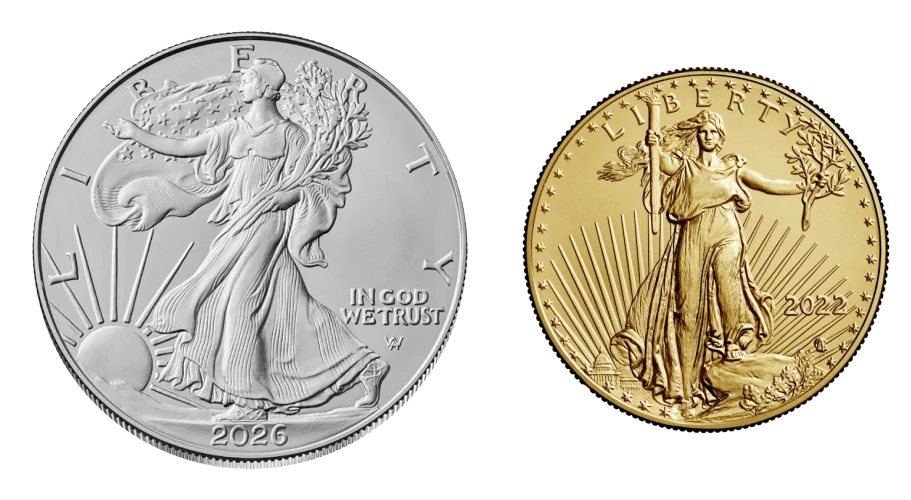
- Silver Eagle
- Gold Eagle
Sales tax at purchase is not the same as tax on a later sale
This is the distinction that causes the most confusion, so it is worth separating carefully.
Sales tax is a tax charged at the time of purchase. It is a state transaction tax, collected by the seller. In Texas, precious metals are not subject to it.
A later sale is a separate question. How the sale of metal you own is treated is not governed by the state sales tax rule and is not something the Texas exemption speaks to at all. Buying without sales tax does not mean a later sale carries no tax consequences.
That second question belongs with a tax professional who knows your full picture. A coin dealer is not in a position to answer it, and any dealer who confidently tells you what you will or will not owe on a future sale is speaking outside their lane. We will not do that here either.
What you can do, and it costs nothing, is keep good records from the beginning. Invoices showing what you paid and when, proof of payment, and a simple inventory of what you hold make the eventual conversation with your tax professional a short one. A holding assembled over years with no paperwork makes it a long one.
The Texas Bullion Depository, as context
Texas established a state-affiliated precious metals depository, the Texas Bullion Depository, which provides storage for gold, silver, and other precious metals. It is worth knowing about for two reasons.
The first is practical. It is a storage option for buyers who would rather not keep metal at home and would rather not use a bank safe deposit box. Depository storage means the metal is held in a secured, insured facility with documented ownership, and it can be sold without shipping it anywhere first.
The second is contextual. A state that stands up a depository for physical metals is a state where owning metals is treated as ordinary commerce rather than as an oddity. Combined with the sales tax treatment, it makes Texas a reasonable place to buy, store, and eventually sell.
Beyond those general points, the specifics of how the depository operates should come from the depository itself.
Where dealer answers end and professional advice begins
A dealer can tell you how tax is handled on an order they are processing. That is their transaction, and they administer it every day.
A dealer cannot tell you what you will owe on a future sale, how a holding should be structured for your situation, what an inherited holding means for an estate, or how any of it interacts with the rest of your finances. Those questions belong to a tax professional, and for estate matters, to an attorney as well. If you are working through an inherited holding, the guide on selling inherited coins covers the practical steps, but the tax side of an inheritance is squarely professional territory.
The reason for drawing the line this clearly is not caution for its own sake. Tax outcomes depend on facts a dealer does not have and should not be guessing at.
Talk to a specialist
If you have a question about an order you are considering, ask before you place it rather than after. Texas Bullion Exchange is a Texas dealer, and staff can confirm how a specific purchase is handled. Call 855-344-2646 to speak with a Texas Bullion Exchange specialist.
For anything touching your own tax situation, a future sale, or an estate, that goes to your own tax professional. This page is educational only and is not tax or legal advice. The right pairing is a TBE specialist for the metal and the transaction, and your tax professional for the tax.